Ghosting Is Not Disappearance. It’s Withdrawal Used as Regulation.
There is a particular kind of confusion that follows ghosting, and it is not the same confusion that follows rejection. Rejection has shape. It has language, however blunt or painful. Someone says no, or says this is not working, or even says nothing kind but says something final. The mind may protest, but it knows what happened. Ghosting does something else entirely. It removes the person without ending the relationship in any psychologically recognizable way. What remains is not loss alone, but suspension.
People often describe this experience as being unable to move on, unable to stop thinking about what happened, unable to trust their own perception of the relationship. From the outside, this can look like overinvestment or emotional fragility. From the inside, it feels like being dropped mid-thought, mid-sentence, mid-reality. Something was occurring. Then suddenly it was not. And no marker was provided to explain the shift.
This is why ghosting is often more destabilizing than direct rejection. The distress does not come only from being left. It comes from being left without context. The mind does not know where to place the ending, so it keeps returning to the last known point of contact, searching for information that never arrives. The result is looping, self-interrogation, and a persistent sense that something important is unresolved.
Most public conversations about ghosting focus on etiquette or morality. Was it rude. Was it immature. Was it cruel. These framings may satisfy outrage, but they do very little to explain why ghosting has the particular psychological impact it does. They also encourage a shallow binary: one person as victim, the other as villain. That binary feels emotionally neat, but it does not actually match how ghosting operates in the mind or in relationships.
To understand ghosting more accurately, it helps to stop treating it as disappearance.
Ghosting is not simply someone vanishing. It is someone withdrawing as a way to regulate their internal state. The silence is not neutral, but it is also not always calculated. In many cases, it is the behavioral outcome of a person encountering emotional complexity they do not know how to manage. Rather than engaging, explaining, or tolerating discomfort, they remove themselves from the interaction altogether. The withdrawal soothes them. The cost is displaced onto the person left behind.
This distinction matters, because it changes how the experience is interpreted. When ghosting is framed as disappearance, the ghosted person naturally assumes the silence reflects their value. If someone vanished, the logic goes, it must be because I was unimportant, unwanted, or easily erased. But when ghosting is understood as regulation, the silence points somewhere else. It reflects the other person’s capacity, not your worth. It reveals a limit in their ability to stay present under emotional strain.
That does not make ghosting harmless. It does not excuse the impact. Withdrawal may regulate one nervous system while destabilizing another. The harm is real precisely because relationships are not private emotional experiments. They involve two minds, two bodies, two realities. When one person exits without acknowledgment, the other is forced to absorb the ambiguity alone.
What makes this especially difficult is that ghosting removes the usual tools people rely on to make sense of endings. There is no conversation to replay, no explanation to accept or reject, no shared recognition that something has concluded. The person who is ghosted is left to construct meaning without collaboration. And in the absence of information, the mind almost always turns inward. The silence becomes evidence. The self becomes the explanation.
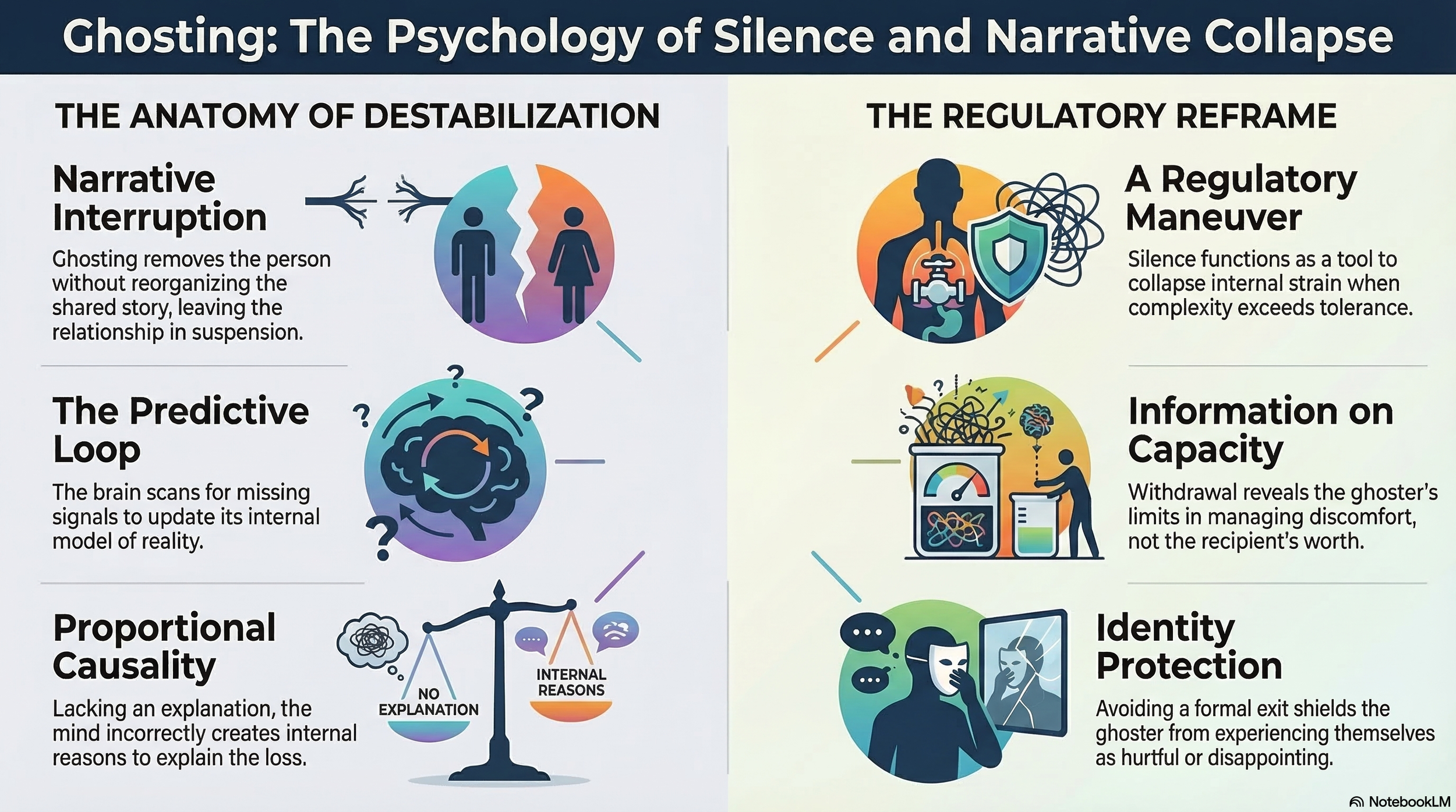
This is not a weakness. It is how human cognition works under uncertainty. The brain is built to complete stories, especially relational ones. When a story stops without warning, the system does not shut down. It searches. It fills gaps. It looks for causality. Ghosting hijacks that process by removing the very data needed to resolve it.
The goal of this essay is not to provide comfort or closure. It is to correct the frame. When ghosting is misread as disappearance, people are left wrestling with the wrong question. Instead of asking what this silence says about them, the more accurate question is what this silence reveals about the other person’s way of managing discomfort, responsibility, and relational strain.
Understanding ghosting as withdrawal used as regulation does not make the experience painless. But it does relocate the meaning. And that relocation is often the first point at which the confusion begins to loosen.
Why the Mind Cannot File Silence
When something ends clearly, the mind knows where to place it. Even painful endings come with edges. Words are spoken. A decision is named. There is a before and an after. Ghosting removes those edges. The relationship does not end in any formally recognizable way; it simply stops being reciprocated. For the mind, that distinction matters more than most people realize.
Human cognition is organized around narrative completion. We do not experience relationships as isolated moments, but as unfolding sequences with continuity and meaning. When a connection changes, the brain expects a signal that allows it to update the story. This is not a preference. It is a structural requirement. Without that signal, the system remains active, scanning for information that would explain the shift.
Silence provides none.
Instead of telling the brain what happened, ghosting creates a vacuum. And vacuums do not remain empty for long. The mind begins to generate hypotheses, replaying conversations, revisiting moments of closeness, scrutinizing tone and timing for clues that might explain the disappearance. This is not rumination in the casual sense. It is an attempt to complete an interrupted cognitive process.
What makes this especially destabilizing is that the last known data point often suggests continuity. In many ghosting scenarios, there was no overt conflict, no expressed dissatisfaction, no visible rupture. The relationship appeared intact right up until it wasn’t. That gap between expectation and outcome creates a form of cognitive dissonance the mind struggles to resolve. Something changed, but nothing was said. The system keeps returning to the last moment that felt real, because it has nowhere else to go.
Clear rejection, by contrast, is cognitively brutal but structurally clean. It hurts, but it closes the loop. Ghosting keeps the loop open. The mind cannot determine whether the relationship ended, paused, or transformed into something unspoken. This ambiguity prevents emotional filing. The experience remains active, unresolved, and psychologically noisy.
In the absence of external explanation, the brain defaults to internal explanation. This is where ghosting becomes so corrosive to self-perception. When no reason is provided, the mind assigns one. And because the only available data is the self, the conclusion often turns inward. The silence is interpreted as evaluation. The absence of response becomes evidence. Meaning is constructed, not because it is accurate, but because uncertainty is intolerable.
This is why people often report that ghosting makes them doubt their own memory of the relationship. They begin to question whether what they experienced was mutual, whether the connection was ever as real as it felt, whether they misread something fundamental. The problem is not that they are naïve or emotionally dependent. The problem is that the mind is trying to reconcile two incompatible realities: felt intimacy and unexplained absence.
Silence does not provide the information needed to resolve that conflict. It only prolongs it.
There is also a temporal distortion that accompanies this process. Because there is no official ending, time does not behave normally. The experience does not recede into the past in the way other losses do. Instead, it hovers. Each new day without contact can feel like a continuation rather than a conclusion. The absence itself becomes the event, repeated over and over, without variation.
This is why well-intentioned advice to simply move on often fails. Movement requires orientation. Letting go requires knowing what one is letting go of. Ghosting denies that clarity. The mind is not clinging to the person so much as it is trying to finish the sentence that was never allowed to end.
Understanding this dynamic is important, because it reframes the aftermath of ghosting as a cognitive consequence rather than a personal deficiency. The looping, the doubt, the fixation on unanswered questions are not signs of weakness or obsession. They are predictable responses to a system that was deprived of the information it needs to complete an experience.
Silence is not neutral to the mind. It is destabilizing. And when a relationship ends without acknowledgment, the mind does not simply accept the loss. It searches for coherence in a space where coherence was never offered.
That search is the beginning of the pain—and also the key to understanding why ghosting leaves such a lasting psychological imprint.
Ghosting as Regulation, Not Disappearance
If ghosting is approached as disappearance, it is almost impossible not to interpret it as erasure. Someone was present, then they were not. The mind fills in the blank with meaning, and that meaning often lands on worth. I was not enough to stay for. I was easy to leave. I did not matter enough to explain things to. These conclusions feel personal because disappearance feels personal.
But disappearance is not the most accurate way to understand what is happening.
Ghosting is better understood as a regulatory act. It is a way of managing internal discomfort by removing oneself from relational contact rather than engaging with what that contact requires. The silence is not an absence of feeling so much as an attempt to quiet feeling. Withdrawal becomes the tool.
This matters because regulation is about the self, not the other. When someone regulates through withdrawal, their primary concern is restoring internal equilibrium, not communicating relational truth. Silence reduces stimulation. It avoids confrontation. It prevents emotional escalation. It protects against having to articulate something difficult, disappointing, or destabilizing. From the inside, it can feel like relief.
From the outside, it feels like abandonment.
Most people assume that when someone ghosts, they are making a statement about the relationship. In reality, they are often making a statement about their own capacity. Capacity for discomfort. Capacity for ambiguity. Capacity for being seen as the one who ends things. Capacity for tolerating another person’s reaction. When that capacity is exceeded, withdrawal becomes the fastest way to regulate.
This is why ghosting so often appears in moments of emotional complexity rather than overt conflict. The connection may have deepened. Expectations may have become implicit. Vulnerability may have increased. Or the person ghosting may have felt a growing internal mismatch they could not articulate cleanly. None of these states require malice to trigger avoidance. They only require insufficient tolerance for relational strain.
Regulation through withdrawal is not unique to ghosting. People regulate through distraction, through overexplaining, through anger, through numbing. Withdrawal is one of the more socially invisible forms. It leaves no trace except silence. And because it leaves no trace, it allows the person who withdraws to avoid seeing the impact of their choice.
That invisibility is part of why ghosting is so easily misread. When harm is loud, it can be contextualized. When harm is silent, it becomes interpretive. The ghosted person is left to guess at motive, meaning, and cause. The person who ghosts is spared that labor entirely.
Understanding ghosting as regulation also explains why explanations so often feel impossible for the ghoster. Explanation requires contact. It requires staying present long enough to be misunderstood, questioned, or experienced as disappointing. For someone already overwhelmed, that prospect can feel intolerable. Silence promises immediate relief. No follow-up. No reaction. No mess.
But relief achieved through withdrawal is one-sided. It stabilizes one nervous system by destabilizing another. The regulation does not eliminate the emotional load; it transfers it.
This is where many discussions about ghosting become confused. They focus on intent rather than function. Was the person trying to hurt someone, or were they just overwhelmed. Did they mean it, or did they drift. These questions miss the point. Regulation does not require intention to have impact. A person can regulate themselves without consciously choosing harm and still cause significant psychological disruption.
Reframing ghosting this way does not sanitize it. It clarifies it. Silence is not neutral. It is an action, even when it is framed as inaction. It reorganizes responsibility by removing dialogue. It allows one person to exit without accounting for the shared reality that existed before the withdrawal.
Most importantly, this frame shifts where meaning belongs. If ghosting is regulation, then the silence is not a verdict on the other person’s value. It is evidence of the ghoster’s limits. Limits in emotional tolerance. Limits in communication. Limits in staying present when things stop feeling simple.
That distinction does not undo the pain. But it changes what the pain is about.
When people remain stuck after being ghosted, it is often because they are trying to extract information from the silence that the silence was never meant to convey. The withdrawal was not a message. It was a maneuver. And once that is understood, the question begins to change.
Not what did this say about me.
But what did this reveal about how the other person manages difficulty.
What Ghosting Protects (and From What)
Ghosting is often described as avoidance, but that description is too thin to be useful. Avoidance tells us what someone did not do. It does not tell us what they were protecting themselves from. When withdrawal is used as regulation, it serves a very specific function: it shields the person from experiences they do not know how to tolerate without destabilizing their sense of self.
One of the most common pressures ghosting protects against is the fear of being experienced as the one who causes harm. Ending a relationship requires occupying an uncomfortable position. It means being the person who disappoints, rejects, or alters the shared story. For some, this is tolerable. For others, it threatens their self-concept. They may see themselves as kind, agreeable, non-confrontational, or emotionally safe. To speak an ending aloud would fracture that image. Silence preserves it.
Ghosting also protects against the unpredictability of another person’s response. Explanation invites reaction. Reaction invites escalation. Even when the ending itself is calm, the conversation carries emotional risk. Someone might be hurt, angry, confused, or ask questions that have no clean answers. For a person with low tolerance for emotional volatility, this can feel overwhelming. Withdrawal collapses the interaction before that risk materializes.
There is also the fear of exposure. Explaining why something no longer works requires naming internal states that may feel incoherent or shame-laden. I don’t feel the same. I’m not who I thought I was. I want something different and don’t know how to justify it. These are not morally wrong statements, but they can feel destabilizing to articulate. Silence avoids having to make one’s internal ambiguity visible.
In many cases, ghosting protects against responsibility itself. Responsibility does not only mean blame. It means acknowledging impact. It means recognizing that one’s choices affect another person’s reality. For individuals who have learned, often early, that relational responsibility leads to emotional overload, withdrawal becomes the least costly option. It allows them to exit without witnessing the consequence.
This is why ghosting can coexist with genuine care. Someone may not want to hurt the other person and still choose the path that hurts them most. The paradox is resolved when regulation is understood as the priority. The immediate need is to stop the internal strain. The relational cost is deferred or minimized in the mind of the ghoster, not because it is insignificant, but because it is unbearable to face.
Ghosting also protects identity narratives. Many people hold implicit beliefs about who they are in relationships. I am easygoing. I don’t create drama. I let things fade naturally. These narratives can make direct endings feel like violations of character. Withdrawal allows the person to maintain continuity with their self-story, even as the relationship collapses. The silence becomes a way of exiting without contradicting the image they have of themselves.
What is rarely acknowledged is that this protection is partial and temporary. Withdrawal may reduce immediate discomfort, but it often leaves unresolved weight behind. Some carry it as quiet guilt. Others as justification. Others as emotional numbness. The regulation works in the short term, but it narrows future capacity. Each avoided ending reinforces the belief that explanation is intolerable. Each silent exit trains further withdrawal.
For the person who is ghosted, none of this is visible. All they encounter is the absence. And absence invites interpretation. Without access to what the silence was protecting, they are left to assume it was about them. This is where the deepest distortion occurs. The ghosted person internalizes a failure that belongs to the other person’s regulatory limits.
Understanding what ghosting protects does not excuse it. Protection is not the same as justification. But it does clarify why ghosting is so common in people who otherwise appear functional, considerate, or emotionally intelligent. The issue is not the absence of feeling. It is the absence of capacity to stay present when feeling becomes complicated.
When this is understood, the silence begins to lose its authority. It no longer functions as an evaluation. It becomes a signal of constraint. A sign that the relationship encountered a threshold the other person could not cross while remaining regulated.
That knowledge does not restore what was lost. But it does reassign meaning to the loss. And that reassignment is often the point at which self-blame begins to loosen.
Why This Gets Misread as Personal Failure
When a relationship ends through silence, the absence does not remain empty. It is interpreted. The mind does not experience unexplained withdrawal as neutral space; it experiences it as information. And because there is no external explanation to work with, the interpretation almost always turns inward.
This is not because people are insecure or self-absorbed. It is because of how meaning is constructed under uncertainty. When something significant disappears without acknowledgment, the brain searches for causality. It looks for a reason that would make the outcome intelligible. In the absence of shared language, the most available explanation is the self.
Silence becomes evaluative by default.
The logic is subtle but powerful. If nothing was said, then perhaps nothing could be said. If no explanation was offered, then perhaps the explanation would have been too obvious, too damning, or too embarrassing to name. The ghosted person begins to assume that the reason must have been self-evident, and that self-evidence points back at them. This is how withdrawal is transformed into judgment.
Ghosting also strips the ghosted person of a basic relational protection: the ability to respond. In conversations that end explicitly, people can ask questions, clarify misunderstandings, or at least register their reality. Silence removes that possibility. The relationship ends unilaterally, without collaboration. And when someone is excluded from the process of ending, they are left with only one place to locate agency: themselves.
This is why ghosting so often produces shame rather than anger. Anger requires a clear object. Shame thrives in ambiguity. When responsibility is unclear, people tend to assume they were the problem. The absence of explanation is experienced as a kind of implicit verdict, even when no verdict was intended.
There is also a deeper psychological mechanism at work. Humans are wired to assume that important events have proportional causes. Big outcomes should have clear reasons. When something meaningful ends without explanation, the mind inflates the cause to match the perceived significance. If the ending felt abrupt and total, the assumed flaw must be equally substantial. Minor explanations do not feel sufficient. The mind reaches for something global: I was fundamentally mistaken. I misjudged everything. There is something wrong with how I show up.
This misreading is reinforced by cultural narratives that emphasize personal responsibility without adequate context. People are encouraged to self-examine, to find their role in relational breakdowns, to look inward for growth opportunities. While reflection is valuable, it becomes corrosive when it is the only available lens. Ghosting deprives people of the external data needed to balance self-reflection with reality. The result is a one-sided accounting.
Another factor is the way ghosting disrupts continuity of identity. Relationships are not just connections to others; they are contexts in which we recognize ourselves. When someone disappears without explanation, it can feel as though the version of oneself that existed in that relationship has been invalidated. If that self was real, why was it not acknowledged? If it mattered, why was it not worth a goodbye? These questions collapse quickly into self-doubt.
This is compounded by the invisibility of the ghoster’s internal process. Regulation through withdrawal happens quietly. There is no visible struggle, no outward sign of conflict or overwhelm. From the outside, it looks effortless. That appearance of ease intensifies the misinterpretation. If leaving was so easy for them, the reasoning goes, then the relationship must have meant very little. And if it meant very little, perhaps it was never real at all.
This conclusion is psychologically devastating, and it is also inaccurate. Ease of withdrawal does not indicate absence of significance. It indicates a particular way of managing strain. But without that context, the ghosted person is left to translate silence into meaning on their own. And that translation almost always skews toward self-indictment.
Understanding this pattern is critical because it interrupts a false chain of inference. Ghosting does not create shame because the ghosted person did something wrong. It creates shame because ambiguity invites self-blame. The mind is trying to restore order in the only way it knows how.
When ghosting is reframed as regulation, this chain begins to break. The silence no longer functions as evidence of inadequacy. It becomes a sign of the other person’s limits in staying present. That does not remove grief, but it removes the illusion that the grief is proof of personal failure.
The absence was not a message about your value. It was a maneuver around discomfort.
Recognizing that distinction does not end the pain. But it does prevent the pain from being misused as a verdict on who you are.
What This Reframe Changes
Understanding ghosting as withdrawal used as regulation does not make the experience easier. It does not retroactively supply the explanation that never came, and it does not convert loss into something neat or justified. What it changes is not the outcome, but the meaning assigned to it.
When ghosting is interpreted as disappearance, the silence carries authority. It feels like a statement about worth, relevance, or replaceability. The unanswered message becomes a verdict. The absence becomes evidence. And the person who was left is forced to live inside an interpretation they never agreed to but cannot easily escape.
Reframing ghosting as regulation removes that authority.
The silence stops functioning as an evaluation and begins to function as information of a different kind. Not information about you, but information about how the other person manages strain. It tells you something real, just not what most people assume. It reveals a threshold that was crossed and a capacity that was exceeded. It points to a limit in staying present, not a conclusion about your value.
This does not excuse the behavior. Regulation achieved through withdrawal still transfers cost. One nervous system stabilizes while another is left to absorb ambiguity alone. The harm remains, even when the motive is not cruelty. Understanding the function of ghosting is not the same as approving of it.
What this reframe does offer is containment. It gives the mind a place to put the experience that is not self-indictment. It allows the story to be completed without inventing a flaw to explain the ending. The relationship did not dissolve because you failed to matter. It ended because the other person could not remain in contact with complexity.
This distinction also clarifies why closure so often remains elusive. If ghosting were a message, it could be decoded. But regulation is not a message. It is a maneuver. Trying to extract meaning from it beyond that function keeps people stuck, searching silence for information it was never designed to convey.
Understanding this changes the internal task. The work is no longer about uncovering what you did wrong. It becomes about recognizing what you were not given and refusing to fill that absence with unnecessary self-blame. It allows grief to be grief, rather than evidence of inadequacy.
This reframe does not promise peace. It does not guarantee detachment or resolution. But it does relocate responsibility to where it belongs. It replaces a corrosive question with a more accurate one. Not what did this say about me, but what did this reveal about how the other person exits when presence becomes difficult.
Ghosting will likely remain a feature of modern relational life. But it does not have to remain a mystery that consumes the people left behind. When silence is understood for what it is, it loses its power to define you.
The absence was real. The impact was real. But the meaning most people assign to it does not have to be.
And that shift, quiet as it may be, is often enough to let the mind finally stop searching for a verdict that was never there.
——-
This essay examines one structural dimension of human functioning. The complete integrative model is developed in The Psychology of Being Human.
For readers who want a deeper structural analysis of ghosting and relational disappearance, the full framework is developed in Gone Without Goodbye: The Psychology of Ghosting Across Love, Friendship, Family, and the Modern World.