Institutional Adoption & Licensing
The Psychology of Being Human: Book + Companion Course Framework
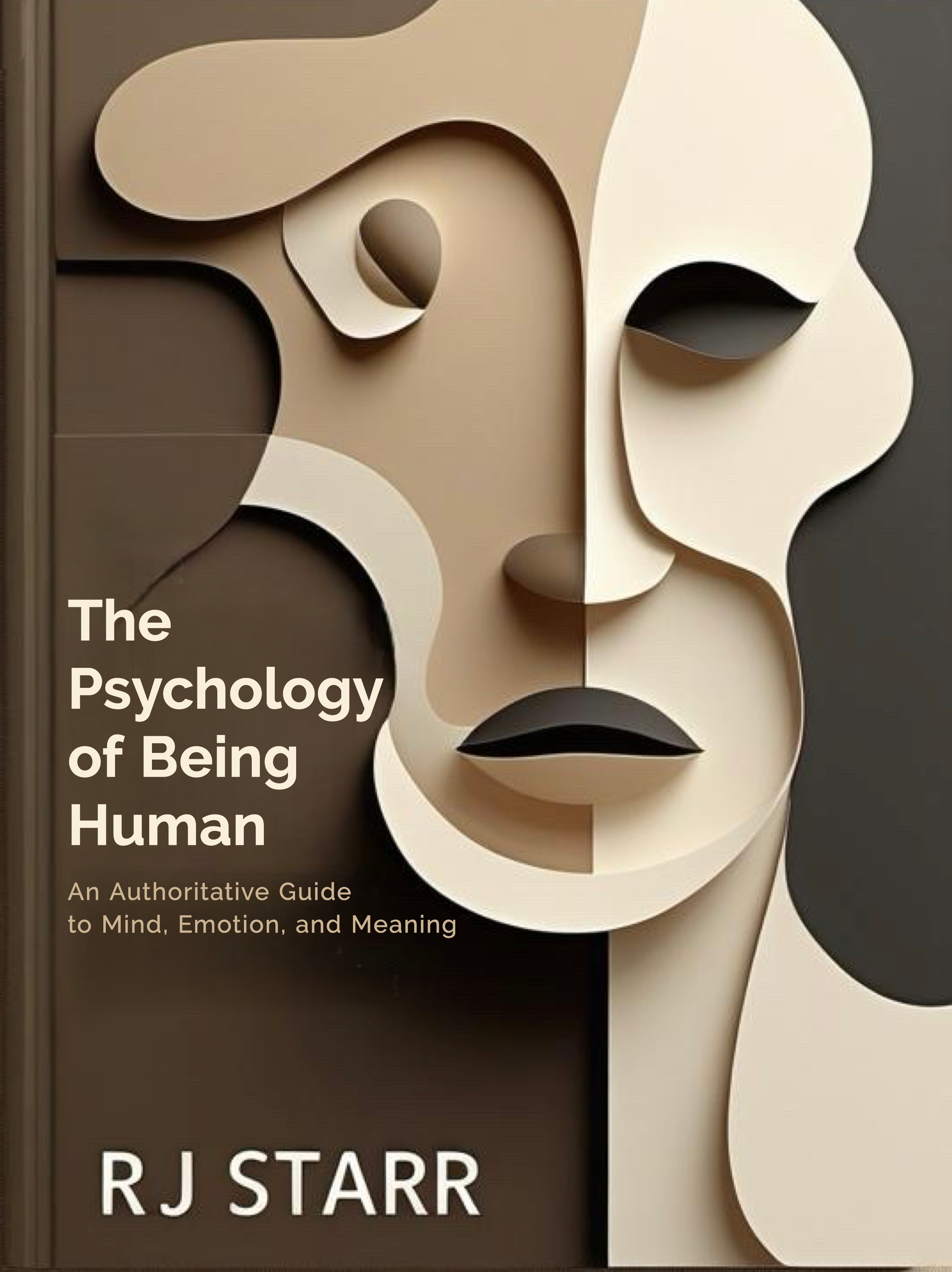
The Psychology of Being Human
ISBN: 979-8-9996293-0-2
Library of Congress Control Number: 2025916521
The Psychology of Being Human presents a comprehensive psychological framework integrating mind, emotion, identity, development, behavior, relationship, and meaning into a coherent system of analysis. The book serves as the conceptual foundation for the structured framework described below.
Institutional Adoption Overview
The Psychology of Being Human is a comprehensive integrative framework designed for advanced academic instruction. It synthesizes cognitive science, developmental theory, affective research, behavioral logic, attachment studies, and meaning-centered inquiry within a unified structural model of human functioning.
This licensing pathway is intended for accredited institutions seeking a coherent psychological architecture capable of supporting capstone integration, graduate-level theory seminars, and interdisciplinary programs. The framework does not offer therapeutic technique or professional certification. It provides conceptual structure. It offers a disciplined lens through which students learn to analyze psychological systems as interdependent rather than fragmented.
Institutional licensing grants structured access to the companion course architecture aligned with the published text, enabling departments to integrate the framework within existing curricula or to adopt it as a standalone offering. The published text is ISBN-registered and cataloged for academic distribution.
Intended Academic Level and Use Context
The Psychology of Being Human is designed for upper-division undergraduate courses, master’s-level instruction, and graduate seminars. The framework assumes conceptual maturity and is most effective in environments where students are prepared to engage psychological theory structurally rather than descriptively.
It is well suited for:
Advanced undergraduate courses in personality theory, lifespan development, identity studies, or counseling foundations
Graduate seminars in theory integration, emotion, identity, and meaning
Interdisciplinary programs integrating psychology, philosophy, human development, or leadership studies
The text is not introductory survey psychology. It functions best where integration, synthesis, and conceptual depth are the pedagogical goals.
Placement Within Academic Sequences
The Psychology of Being Human is best situated where synthesis rather than introduction is the pedagogical objective. Its integrative structure makes it particularly well suited for:
Capstone courses for advanced undergraduates seeking to consolidate knowledge across cognitive, developmental, social, and personality domains.
Core theory seminars in master’s programs where students must move beyond discrete models toward conceptual integration.
Doctoral special topics courses examining identity, emotional regulation, attachment, meaning, or integrative theory.
The text is less suited to introductory survey sequences and more effective where students have already encountered foundational material and are prepared to examine how those domains interlock. It functions as a unifying framework rather than a content sampler.
The Book: Intellectual Architecture
The manuscript is organized into major parts that progressively expand the psychological frame from foundations to integration.
Part I: Foundations of the Human Mind
The opening section establishes psychology as disciplined inquiry into human experience. It addresses:
What psychology is and how it defines evidence
The interplay of nature and nurture
The architecture of mind: perception, attention, memory, emotion, and consciousness
The formation of self and identity
Development across the lifespan
Students are grounded in structural thinking. Personality, development, and identity are presented as dynamic systems rather than isolated categories.
Part II: Emotion, Regulation, and Resilience
This section examines affective life and regulation:
The evolutionary and neurological function of emotion
Emotional granularity and individual differences in sensitivity
Dysregulation, avoidance, and numbing
Resilience as architecture rather than trait
The cultural myth of “healing”
Emotion is treated as organizing signal rather than pathology. Regulation is explored in developmental, relational, and neurobiological terms, linking domains often segmented in traditional curricula.
Part III: Behavior, Habit, and Self-Control
This section addresses behavioral logic and reinforcement dynamics:
What behavior reveals about internal systems
Reinforcement and conditioning
Self-control and habit formation
The limits of insight without embodied change
Behavior is framed as patterned adaptation, integrating conditioning science with identity structure and emotional regulation.
Subsequent Sections: Relationship, Belief, Culture, and Integration
Later portions of the book extend the framework outward:
Attachment and relational dynamics
Trauma, memory, and the persistence of the past in the present
Meaning, morality, and psychological exhaustion
Cultural distortion of psychological language
Integration as psychological adulthood
The final chapters articulate psychological maturity as the capacity to hold complexity without fragmentation.
Across 600+ pages, the text constructs a coherent psychological lens integrating cognitive, developmental, affective, relational, and cultural domains within a unified conceptual frame.
Differentiation from Standard Texts
Most psychology textbooks organize the field into discrete domains. Cognition, development, social psychology, abnormal psychology, personality, and neuroscience are presented as parallel territories. This structure provides breadth, but it often leaves students responsible for performing the integration themselves.
The Psychology of Being Human is organized differently. Rather than segmenting the discipline into chapters that operate independently, it treats psychological domains as interdependent systems. Emotion is not isolated from cognition. Attachment is not detached from identity. Reinforcement dynamics are not separated from meaning. Development is not confined to early life but understood as an ongoing structural process.
The framework does not function as a survey of findings. It functions as an interpretive architecture. Its aim is not to introduce additional theories into the field, but to clarify how existing domains interlock within a coherent model of human functioning.
Where many texts emphasize coverage, this text emphasizes integration. Where many courses train students to compare competing models, this framework trains them to analyze structural interdependencies across them.
The result is a shift in intellectual posture. Students move from memorizing domains to understanding systems.
Student Intellectual Development and Applied Analysis
The central pedagogical value of the framework lies in how it reshapes student analysis.
Rather than approaching psychological material as competing theories or isolated findings, students learn to examine how cognitive processes, emotional regulation, attachment patterns, reinforcement dynamics, and identity structures operate within a single system.
For example, when analyzing a case involving trauma, a student using a standard multi-theory approach might alternate between attachment theory, conditioning models, and cognitive distortions as separate lenses. Within this framework, the student is trained to examine how attachment history shapes emotional granularity, how threat detection alters attention, how reinforcement patterns stabilize avoidance, and how identity defenses preserve coherence under stress.
The result is not diagnostic labeling but structural analysis. Students develop the capacity to synthesize domains, trace interdependencies, and articulate psychological processes without fragmenting them into disconnected explanations.
This capacity directly supports graduate-level competencies in theoretical integration, systems thinking, and advanced conceptual reasoning.
The Companion Course: Structured Delivery Framework
The companion course is not a condensed version of the book. It is a pedagogical architecture designed to translate the manuscript’s integrative logic into teachable sequence.
Organized into eight modules and twenty-four lessons, the course framework isolates major psychological domains while preserving their structural interdependence. Each module deepens a central dimension of human functioning, progressively expanding from foundational architecture toward integration.
The sequence begins with orientation to the human system itself. Students examine struggle as systemic pressure rather than personal deficiency and learn to observe psychological processes without premature correction. This establishes the interpretive stance required for the remainder of the course.
Attention and narrative are then examined as identity-forming forces. Rather than treating identity as fixed trait or diagnostic label, the framework explores how narrative strategies stabilize coherence and how defensive rigidity emerges under threat.
The module on emotion reframes affect as organizing signal. Suppression, dysregulation, and emotional performance are analyzed not as failures of will but as adaptive responses shaped by development and environment.
From there, the course turns to defensive logic and self-deception. Students examine how avoidance functions as protective intelligence and how identity coherence is maintained through distortion when structural pressure increases.
Relational life is addressed through attachment and co-regulation. Emotional regulation is treated as relationally scaffolded before it becomes individual capacity. Patterns are examined over labels, with emphasis on depth and trigger sensitivity rather than categorical description.
Memory and threat processes are then explored as reconstructive and physiological phenomena. Students analyze how the past persists in the present not only symbolically but somatically, and how threat detection reorganizes attention and behavior.
The final modules address meaning, exhaustion, and integration. Meaning is examined as psychological load as well as organizing force. Moral self-surveillance, burnout, and fragmentation are treated as structural outcomes rather than moral failures. Integration is defined as the capacity to hold ambiguity and complexity without collapse into rigidity.
Whether taught in full sequence or in selected modules, the course maintains architectural coherence. The aim is not accumulation of concepts but development of structural literacy: the ability to interpret psychological phenomena as interdependent systems rather than isolated events.
Examples of Curricular Integration
The modular structure of the companion course allows departments to integrate the framework flexibly without restructuring entire programs.
Modules 1 through 3 may be used to provide theoretical backbone to a graduate foundations course that currently draws from disparate readings. These modules establish architecture of mind, emotion as signal, and behavioral adaptation within a unified system.
Modules 5 and 6 offer substantial depth for courses in human development, attachment, or trauma counseling. They connect relational regulation, memory reconstruction, and physiological threat processes within an integrative frame.
Modules 7 and 8 are particularly well suited for seminars on adult development, identity consolidation, moral psychology, or the psychology of meaning. They examine exhaustion, moral self-surveillance, and psychological maturity as structural phenomena rather than moral narratives.
Departments may adopt the full sequence as a semester-long course or incorporate selected modules into existing curricula. The architecture remains coherent whether taught in full or in part.
Faculty Implementation and Adoption Structure
Institutional licensing provides structured access to the companion course framework aligned with The Psychology of Being Human. The license grants permission to teach the architecture within accredited programs and includes the materials necessary for curricular integration.
Departments receive a complete module and lesson outline, detailed synopses suitable for syllabus construction, and conceptual scaffolds designed to support advanced discussion and written analysis. Sample discussion prompts and illustrative case applications are available upon request to assist faculty in aligning the framework with existing course objectives.
The materials are designed to integrate rather than replace. Faculty may adopt the full sequence as a semester-length course, embed selected modules within established offerings, or use the text as the conceptual backbone of theory integration seminars.
Because the framework emphasizes structural synthesis across domains, it aligns naturally with graduate-level learning outcomes such as theoretical integration, systems analysis, and advanced conceptual reasoning. The materials support programs seeking to cultivate interpretive coherence rather than isolated technical proficiency.
The licensing model does not require the author’s direct instructional involvement. It provides the intellectual and pedagogical architecture; faculty retain full control over instructional method, assessment design, and contextual adaptation.
Optional consultation is available for departments seeking guidance on curricular placement or alignment with program competencies.
Academic Positioning
This framework serves institutions seeking an integrative psychological architecture capable of bridging cognitive science, developmental theory, affective research, relational dynamics, and meaning-centered inquiry within a single coherent structure.
The text does not function as skills training, therapeutic protocol, or professional certification. It is not oriented toward symptom management or intervention technique. Its contribution is conceptual: it clarifies how psychological domains interrelate and how structural pressures shape human functioning across the lifespan.
For psychology departments, it offers a unifying lens through which disparate theoretical traditions may be synthesized. For counseling and human development programs, it deepens theoretical literacy without collapsing into clinical prescription. For interdisciplinary curricula, it provides a psychologically rigorous foundation for examining identity, morality, culture, and adulthood.
The framework assumes intellectual maturity. It invites students to move beyond model comparison and into structural analysis. Its emphasis is coherence, integration, and interpretive depth.
Institutions adopting this work are not acquiring a supplementary text. They are licensing an architectural framework for understanding human systems.
Licensing Structure
Licensing arrangements are customized based on number of students, departmental scope, duration of use, and implementation format. Terms and pricing are provided upon institutional inquiry.
For curriculum review, sample materials, or licensing discussions, please contact: licensing [at] profrjstarr [dot] com