

Selected Books
Focused works exploring the psychological conditions of modern human life
This page presents a focused selection of books that most clearly represent the central questions and psychological perspectives structuring this body of work. These titles reflect long-form inquiries into human experience as it unfolds under cultural, emotional, and systemic pressures, rather than a comprehensive catalog of all publications.
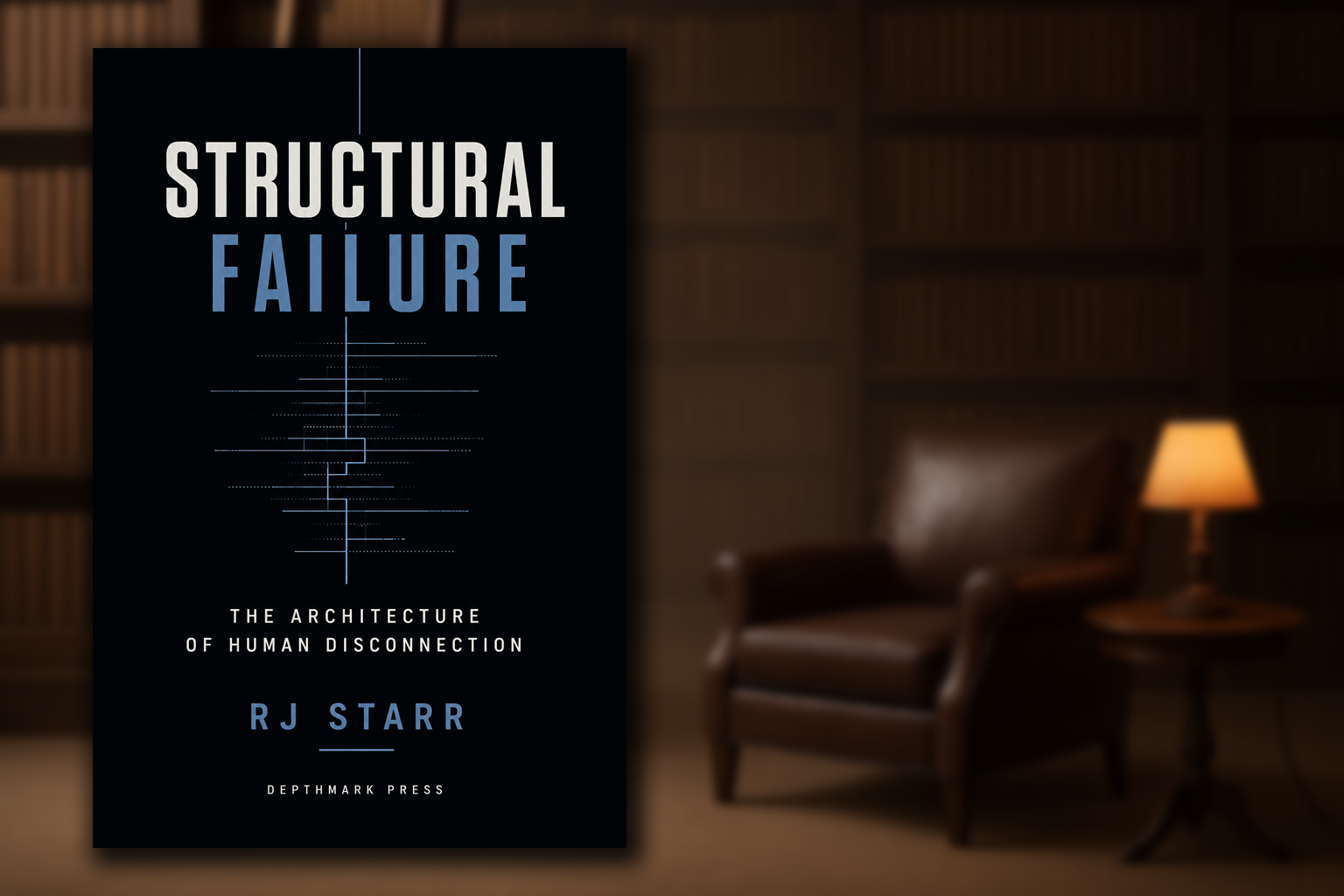
Structural Failure: The Architecture of Human Disconnection
Structural Failure argues that the ambient disconnection of contemporary life is not a moral, political, or technological failure — it is a structural one. Drawing on Psychological Architecture, the book examines how psychological systems operating exactly as designed produce disconnection as a reliable output under current conditions.
The work addresses the mechanisms behind misreading, ghosting, contempt, belief rigidity, identity defensiveness, and the quiet failure of recognition inside the relationships people depend on most. It is a diagnostic work, not a prescriptive one. It does not propose remedies. It offers something rarer: an accurate structural account of what is actually happening, and why.
The Architecture of Being Human
The Architecture of Being Human presents a structural framework for understanding how mind, emotion, identity, and meaning function as an integrated system. It introduces Psychological Architecture in a form designed for clarity and accessibility, offering an entry point into the broader framework.
Where the formal monograph articulates the theoretical model in academic terms, this volume translates that structure into a more readable, applied form. It retains the integrity of the system while making its core ideas visible and usable to a wider audience.
The book develops a unified model of human experience in which interpretation, emotional regulation, identity formation, and meaning operate as interacting domains shaping perception and continuity across a life.
It begins from a central observation: most people live within psychological systems they rarely perceive directly. Thoughts, emotions, and self-understandings feel immediate, yet emerge from an underlying structure organizing how experience unfolds.
This volume serves as the primary entry point into Psychological Architecture.

The Psychology of Being Human
The Psychology of Being Human: An Authoritative Guide to Mind, Emotion, and Meaning presents a comprehensive exploration of human experience, examining how cognition, emotion, identity, attachment, perception, and meaning interact within the life of the individual.
The book develops a unified view of psychological functioning, moving beyond isolated concepts to consider how these dimensions shape perception, behavior, and continuity across time. Rather than offering strategies or prescriptions, it focuses on how experience is organized and why it takes the forms it does.
In this work, the self is approached not as a collection of traits, but as an interdependent structure shaped by interpretation, emotional response, narrative continuity, and meaning. It examines how coherence is established, how it becomes strained, and how it reorganizes across a life.
This volume represents an early articulation of the ideas that would later be formalized within Psychological Architecture.

The Burden of Freedom: Existential Psychology and the Human Struggle with Uncertainty
The Burden of Freedom explores how freedom — the capacity to choose and direct one’s life — can also become a source of psychological burden, anxiety, and moral weight. Building on existential theory and psychological inquiry, the book examines how human beings confront uncertainty, ambiguity, and the profound responsibility of self-creation. It shows that freedom is not only an opportunity but also a challenge that can erode coherence and generate chronic self-doubt. (Inference based on book theme.)
Framed through psychological insight rather than abstract philosophy, this work bridges lived experience and existential thought. It invites readers to reconsider cultural narratives that equate freedom with ease or self-actualization, and instead asks: What does it take to live with uncertainty without collapsing into denial, despair, or distraction? This book deepens your understanding of how agency shapes the psyche and why meaning often feels elusive despite freedom’s promise.

The Myth of Healing: Reclaiming Wholeness in a Culture That Pathologizes Being Human
The Myth of Healing reframes the familiar cultural narrative that healing is a journey from dysfunction to function. Instead, Starr argues that modern psychology — and often popular self-improvement culture — treats human complexity as a set of deficits to correct. This book challenges that paradigm by emphasizing presence, permission, and depth as the foundations of authentic psychological growth.
Rather than offering techniques for symptom reduction, the work invites readers to recognize that emotional life is not broken but layered, contextual, and often misunderstood. Wholeness isn’t a destination to be reached through external fixes; it’s an ever-evolving relationship with one’s own experience. By questioning the assumptions of pathology, this book expands how we think about development, resilience, and psychological maturity.

The Psychology of Modern Inadequacy
The Psychology of Modern Inadequacy investigates the modern phenomenon of perpetual self-optimization and the emotional toll it takes. In an era that prizes performance and continual improvement, many people feel quietly unravelled, even when doing “everything right.” This book examines how comparison, productivity narratives, and cultural expectations create a psychological backdrop in which adequacy always feels just out of reach.
Instead of pathologizing individuals, the work situates feelings of inadequacy within cultural and systemic pressures, showing how the constant chase for more often undermines coherence, belonging, and self-trust. It reframes the experience of falling short not as personal failure, but as a natural response to an environment that rewards performance over presence — an insight that deepens rather than dismisses what many feel but cannot articulate.

The Psychology of the Artificial Era
The Psychology of the Artificial Era examines what it means to remain psychologically whole when technology increasingly mirrors and amplifies human capacities. Rather than presenting AI as threat or savior, the work treats the artificial age as a psychological condition — one where identity, agency, and connection are refracted through systems that simulate intelligence, empathy, and presence.
Through research, philosophy, and cultural insight, the book outlines how emotional resilience, cognitive flexibility, and moral reasoning become the new literacies of our time. Starr reframes artificial intelligence as a mirror that reveals not just technological capability but longstanding human patterns of imitation, distraction, and self-definition. The central argument is that human relevance in this era depends less on technical skill than on awareness, integration, and ethical depth.

Gone Without Goodbye: The Psychology of Ghosting Across Love, Friendship, Family, and the Modern World
Gone Without Goodbye examines how abrupt relational disappearances — “ghosting” — reflect deeper psychological patterns in attachment, belonging, and emotional regulation. Beyond a cultural trend, Starr situates ghosting within the landscape of modern social networks, digital communication, and shifting expectations of presence and reciprocation. This book explores what such absences reveal about trust, fear, avoidance, and the ways people sometimes protect themselves by withdrawing. (Based on title theme.)
The work connects individual experience with broader cultural dynamics, showing that avoidance and abrupt disengagement are not isolated behaviors, but part of how relational life is shaped by speed, distraction, and emotional risk. Readers come away with a psychological vocabulary for understanding loss, connection, and the internal tensions that shape how we relate, withdraw, and sometimes re-emerge.

The Stories We Tell Ourselves: How Personal Narratives Shape Your Life
The Stories We Tell Ourselves explores how the narratives we construct — about ourselves, our relationships, and our place in the world — shape emotion, behavior, and identity. Personal stories are not passive recollections; they are frameworks through which experience is filtered, interpreted, and given meaning. This book examines how these internal narratives reinforce or undermine clarity, purpose, and coherence.
Rather than treating story as a metaphor alone, Starr investigates the architectural role of narrative in psychological life: how early experiences, cultural templates, and internal assumptions interact to produce the stories we carry. By illuminating how narrative forms, fragments, and evolves, the work offers readers greater agency in reshaping the internal scripts that often determine how they see themselves and the world.