
Ghosting as Regulatory Failure: Withdrawal, Identity Protection, and the Collapse of Exit Capacity
Ghosting is commonly described as avoidance, but avoidance is only the visible behavior. What matters psychologically is not that someone disappears, but why disappearance becomes the preferred regulatory response when relational strain increases. This analysis treats ghosting not as a social misstep or moral lapse, but as a structural failure that emerges when a system lacks the capacity to exit cleanly under emotional load.
Public discussions of ghosting tend to emphasize harm, etiquette, or intent. These frames capture impact, but they do not explain mechanism. They also obscure a critical asymmetry: ghosting stabilizes one internal system by destabilizing another. The relief experienced by the withdrawing party is not incidental. It is the function. Silence is not passive. It is an action that redistributes psychological load by removing relational contact rather than metabolizing it.
This study approaches ghosting as a failure of exit capacity. Exit capacity refers to the psychological ability to bring a relational process to an end while remaining present, accountable, and internally regulated. It is not a communication skill and not a personality trait. It is a developmental function shaped by emotional tolerance, identity stability, and the ability to withstand being experienced as the source of disappointment. When that capacity collapses, withdrawal becomes the default solution.
Understanding ghosting this way shifts the analytic focus away from individual moments and toward structure. The question is no longer why someone chose not to respond, but what internal constraints made explanation, acknowledgment, or presence feel intolerable. These constraints often involve identity protection, fear of relational consequence, and avoidance of ethical load. Ghosting preserves internal equilibrium by transferring ambiguity, confusion, and unresolved meaning to the other party.
This analysis does not treat ghosting as neutral, nor does it reduce it to intention. Regulatory maneuvers can cause harm without malice, and structural failures can persist even in otherwise functional individuals. The interest here is not judgment, but clarity: how withdrawal becomes trained, reinforced, and normalized as a way of managing relational endings, and what that pattern reveals about psychological development within contemporary systems.
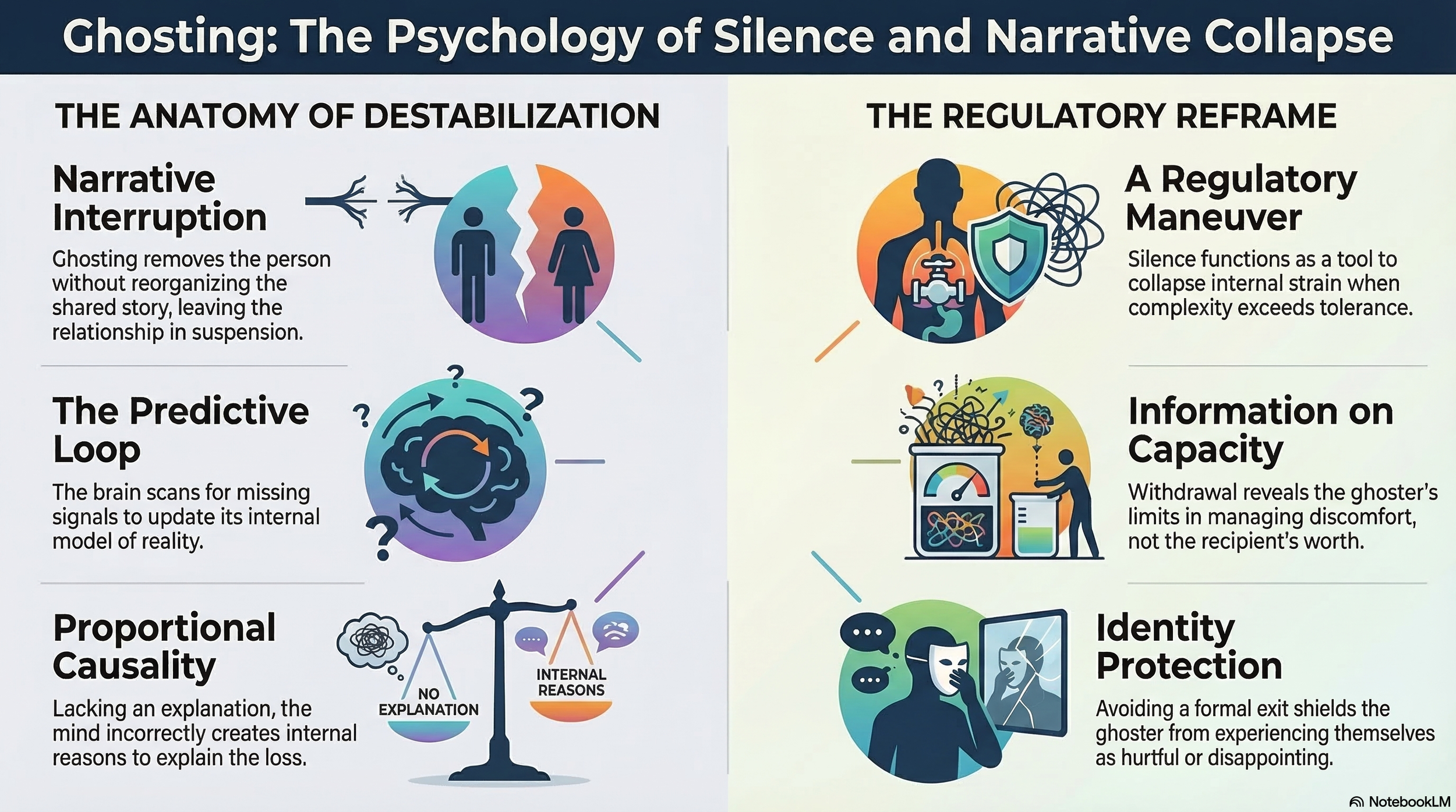
Regulation Under Load
When relational strain increases, people do not respond according to values or insight. They respond according to capacity. Regulation becomes the governing priority, and the system reaches for whatever action most quickly reduces internal load. In this context, ghosting is not an anomaly. It is a predictable outcome when engagement exceeds tolerance and no viable exit pathway is available.
Regulation under load is not inherently pathological. All psychological systems manage pressure by narrowing options. Attention contracts. Time horizons shorten. The aim becomes stabilization rather than meaning. In relational contexts, however, this narrowing has consequences because regulation does not occur in isolation. One person’s stabilization strategy becomes another person’s destabilizing event. Ghosting is a case study in this asymmetry.
As emotional complexity increases, explanation becomes costly. Explanation requires sustained presence, emotional clarity, and tolerance for response. It invites questions, disappointment, and the possibility of being misunderstood. Under sufficient load, these demands can feel overwhelming. Withdrawal offers a faster solution. It reduces stimulation, eliminates immediate relational demand, and restores a sense of internal quiet. The silence is not accidental. It is functional.
What differentiates ghosting from other forms of withdrawal is not intensity but finality. Many people disengage temporarily when overwhelmed. Ghosting occurs when withdrawal is used not as a pause but as a substitute for ending. The relational process is terminated through absence rather than acknowledgment. This allows regulation to occur without confrontation, without articulation, and without witnessing the other person’s response.
From the inside, this often feels necessary rather than chosen. People who ghost frequently report feeling trapped, flooded, or unable to find the right words. The experience is less one of decisiveness than of collapse. Presence becomes unsustainable. Silence feels like the only available option. The fact that this option externalizes cost does not register fully in the moment, because regulation has already become the dominant goal.
This helps explain why ghosting often follows moments of increased intimacy rather than conflict. As expectations become implicit and emotional stakes rise, the regulatory demands of staying present increase. For individuals with limited tolerance for relational strain, the system reaches threshold. Withdrawal becomes the most efficient way to restore equilibrium, even if it violates relational norms.
It is important to note that regulation through withdrawal is often reinforced by short-term relief. The immediate reduction in anxiety confirms the strategy. No conversation occurred. No reaction was witnessed. The system calmed. This reinforcement strengthens the likelihood of future withdrawal under similar conditions. Over time, silence becomes a learned regulatory solution rather than an exceptional response.
This pattern also explains why ghosting can coexist with otherwise high functioning behavior. Regulation under load does not require global dysfunction. It requires a specific vulnerability at points of relational exit. Someone may manage complexity well in many domains and still lack the capacity to remain present at the moment a relationship needs to be acknowledged and ended.
When viewed through this lens, ghosting is not a failure of caring. It is a failure of containment. The system cannot hold the emotional, ethical, and relational demands of an ending simultaneously. Withdrawal resolves the internal pressure by collapsing the relational field.
Understanding ghosting as regulation under load clarifies why appeals to empathy or responsibility often miss their mark. When regulation is dominant, moral reasoning is secondary. The system is not evaluating right and wrong. It is attempting to survive the moment without destabilization. This does not absolve the behavior, but it does locate its origin.
This framing also sets the stage for the deeper question that follows. If ghosting is a regulatory response to load, then the central issue is not avoidance itself, but the absence of a functional exit capacity that could allow regulation and responsibility to coexist. That absence is not random. It is developmental.
Exit Capacity as a Psychological Function
Exit capacity refers to the ability to bring a relational process to an end while remaining present, regulated, and accountable for the impact of that ending. It is not synonymous with communication skill, emotional intelligence, or relational maturity in the abstract. It is a specific psychological function that comes online when a relationship must be concluded and pressure is high.
This function is often misunderstood because it does not announce itself during periods of stability. Exit capacity is revealed at moments of strain. It appears when someone must tolerate being the source of disappointment, confusion, or loss for another person without collapsing internally or resorting to disappearance. In those moments, what matters is not what someone knows about healthy relationships, but what their system can withstand.
Exit capacity is developmental. It emerges from early experiences in which endings were acknowledged, emotions were held without retaliation, and responsibility did not lead to abandonment or overwhelming consequence. When those conditions are present, individuals learn that endings, while uncomfortable, are survivable. Presence remains possible even when relational harmony dissolves. When those conditions are absent, the system learns a different lesson. Endings become associated with danger, exposure, or loss of self.
In such systems, exit capacity does not fail gradually. It collapses. The individual may function well until the moment an ending must be named. At that point, the internal cost of staying present exceeds tolerance. Withdrawal becomes the only accessible form of regulation. The person does not lack awareness of impact. They lack the capacity to remain in contact with it.
This distinction is critical. Many people who ghost are capable of empathy, reflection, and care. What they cannot tolerate is the sustained experience of being perceived as the one who ends things. The identity threat is not abstract. It is felt as destabilizing. To speak the ending aloud would require holding a version of the self that feels incompatible with internal coherence.
Exit capacity is therefore closely tied to identity stability. Individuals with flexible identity structures can absorb moments of being disliked, disappointing, or misunderstood without fragmentation. Those with more brittle identity structures experience such moments as threats to continuity. Ghosting preserves identity by removing the relational mirror altogether. The ending occurs without being seen.
This also explains why exit capacity often decreases rather than increases over time. Repeated withdrawal trains the system to associate silence with relief. Each avoided ending reinforces the belief that explanation is intolerable. The function is not exercised, and what is not exercised does not strengthen. Over time, the threshold for collapse lowers. Withdrawal becomes the default response earlier and more reflexively.
Importantly, exit capacity is not restored by insight alone. Knowing that ghosting causes harm does not increase tolerance for being the source of that harm. Capacity develops through experience in which presence during endings does not result in catastrophic internal or relational consequences. Without those experiences, the system continues to equate presence with danger.
Understanding ghosting as a collapse of exit capacity shifts the analytic focus again. The issue is not whether someone should have said something. It is why saying something felt impossible. That impossibility is not a mystery or a moral flaw. It is a learned constraint shaped by developmental history and reinforced by short-term regulatory relief.
This does not make ghosting benign. It clarifies why it persists even among people who otherwise value honesty and care. When exit capacity collapses, values lose their leverage. Regulation takes precedence. The ending occurs in the only way the system knows how to survive it.
Identity Protection and the Fear of Being the One Who Ends Things
Exit capacity collapses most reliably at the point where ending a relationship threatens identity continuity. For many individuals, the difficulty is not the loss of the relationship itself, but the position they would have to occupy in order to end it. Ghosting functions as a way to avoid inhabiting that position.
Most people carry implicit identity narratives about who they are in relationships. These narratives are not abstract values; they are organizing structures. I am easy to be with. I do not cause pain. I am not dramatic. I do not hurt people. These self-concepts regulate behavior long before conscious choice enters the picture. When an ending would require violating one of these narratives, internal coherence comes under strain.
To end a relationship explicitly is to accept being experienced as the source of loss. Even when an ending is justified, mutual, or necessary, someone must occupy the role of initiator. For individuals whose identity is tightly organized around being agreeable, safe, or emotionally low-impact, this role can feel intolerable. The system does not experience it as a temporary discomfort, but as a threat to self-recognition.
Ghosting preserves identity by eliminating the mirror. Without dialogue, there is no moment in which the self must be seen as disappointing, rejecting, or harmful. The ending occurs without the identity cost of being witnessed in that role. Silence allows the individual to maintain internal consistency while exiting the relational field.
This is why ghosting often feels subjectively non-aggressive to the person who withdraws. From the inside, the act is experienced less as doing something to another person and more as stepping away from an untenable internal position. The harm is real, but it is not registered in the same way, because the identity threat has been neutralized.
Identity protection also explains why ghosting is often accompanied by rationalizations that minimize relational obligation. The connection is reframed as incidental, provisional, or already dissolving. By reducing the perceived reality of the relationship, these narratives lower the internal cost of withdrawal. The exit is then experienced as proportionate rather than avoidant, preserving identity coherence while bypassing acknowledgment.
What is avoided is not only the other person’s reaction, but the internal experience of being the one who ends something meaningful. That experience requires holding complexity: caring and disappointing, relief and guilt, honesty and harm. For individuals with limited tolerance for such complexity, identity protection takes precedence over relational accountability.
This pattern is reinforced culturally. Many environments reward smooth exits, minimal friction, and emotional efficiency. Discomfort is treated as something to be managed privately rather than metabolized relationally. In such contexts, identity narratives that prioritize being unproblematic or emotionally light are validated. Ghosting becomes a socially invisible way to maintain those identities without overt violation.
Over time, identity protection through withdrawal narrows relational range. The system becomes organized around avoiding positions that require bearing negative impact. Relationships may form easily but end poorly, because the identity cannot accommodate the full arc of relational reality. The individual remains attached to a self-image that can only be preserved by disappearing at moments of consequence.
For the person who is ghosted, none of this is visible. What they encounter is silence, not identity defense. The absence is interpreted as indifference or judgment, when it is more accurately understood as an inability to remain coherent while occupying the role of the one who ends things.
Recognizing ghosting as identity protection clarifies why appeals to kindness, honesty, or maturity often fail. These appeals target values, not identity structure. When identity coherence is at stake, values are subordinated to preservation. The system chooses continuity of self over continuity of relationship.
This reframing does not reduce the harm of ghosting. It locates it. The injury is not only relational; it is structural. One person’s identity is stabilized by withdrawing, while the other is left to absorb the ambiguity and loss without acknowledgment. That asymmetry is not accidental. It is the mechanism by which identity protection succeeds.
The Ethical Weight of Presence and the Cost of Withdrawal
Ghosting is often discussed as a failure of communication, but its deeper consequence is ethical rather than interpersonal. Ethics, in this context, does not refer to intent or character. It refers to how responsibility is distributed when one person exits a shared reality. Presence carries ethical weight because it acknowledges impact. Withdrawal avoids that weight by removing the relational field in which responsibility would otherwise be borne.
Ethical responsibility in relationships is not created by wrongdoing. It is created by involvement. Once two people have established mutual recognition, the ending of that recognition carries consequence regardless of motive. To remain present long enough to acknowledge an ending is to accept being part of that consequence. Ghosting functions as a way to exit without carrying that load.
This is why silence feels different from other forms of harm. It does not confront, accuse, or even reject. It simply removes itself. Yet that removal forces the remaining person to absorb the full ethical burden of meaning-making alone. They are left to determine whether the relationship mattered, whether it ended, and what that ending signifies. The ethical asymmetry is complete. One person preserves internal stability by disappearing. The other inherits ambiguity without consent.
Presence, by contrast, requires tolerating the experience of being seen as the source of loss. It requires staying long enough to allow the other person to register reality, even if that reality is painful. This is not a moral ideal. It is a structural function of relational ethics. Responsibility is not discharged by good intentions or private justification. It is discharged through acknowledgment.
Withdrawal avoids acknowledgment entirely. It allows the withdrawing party to bypass the moment where their choice intersects with another person’s emotional reality. The harm is not only that the relationship ends, but that the ending is privatized. The person who leaves retains authorship of their internal narrative while the person who is left is denied authorship of the shared one.
This is why ghosting produces a distinctive kind of injury. The pain is not only about loss. It is about exclusion from the ethical process of ending. The person who is ghosted is denied participation in the transition from connection to separation. They are forced to accept an outcome without being recognized as someone to whom something happened.
Ethical load-bearing requires presence precisely at moments when presence is uncomfortable. It requires remaining in contact when coherence is threatened, when one’s self-image is challenged, or when emotional complexity exceeds preference. Ghosting represents a refusal of that load. The system resolves pressure by collapsing the ethical field rather than engaging it.
This refusal does not require malice. It requires insufficient capacity to hold being experienced as consequential. When capacity collapses, the ethical dimension of presence is experienced as intolerable rather than necessary. Withdrawal becomes the path of least resistance, even when its cost is displaced onto someone else.
Over time, repeated withdrawal reshapes ethical expectation. The system learns that it is possible to exit without acknowledgment, and that doing so is survivable. The absence of immediate consequence reinforces the behavior. What is lost is not only trust between individuals, but the expectation that relational endings require shared recognition. The ethical standard quietly erodes.
This erosion has broader implications. When withdrawal becomes normalized, relationships become provisional by default. Connection is allowed without commitment to acknowledgment at its conclusion. People learn to invest with caution, anticipating disappearance rather than dialogue. The relational field thins. Presence becomes conditional, and ethical responsibility becomes optional.
Understanding ghosting through this lens clarifies why the behavior feels so destabilizing even when it is common. It violates an implicit ethical contract that says shared realities deserve shared endings. When that contract is broken through silence, the injury is not only emotional. It is structural. Responsibility has been redistributed without agreement.
Ghosting is therefore not merely a personal failing or cultural trend. It is an ethical failure of presence under load. The system chooses internal regulation over shared accountability, leaving one person stabilized and the other holding what was never acknowledged.
Capacity Collapse Versus Boundary Setting
Ghosting is frequently defended as a form of boundary setting, but this conflation obscures a crucial psychological distinction. Boundaries are regulatory structures that preserve contact while defining limits. Capacity collapse eliminates contact because limits cannot be held internally. The two may look similar on the surface, but they operate in opposite directions.
A boundary requires presence. It involves staying in the relational field long enough to name what will and will not be carried. Even when the boundary results in separation, it preserves shared reality by acknowledging the other person as someone to whom an explanation is owed. Boundaries regulate engagement without erasing recognition. They constrain behavior, not existence.
Capacity collapse does something else. It removes the relational field altogether. The withdrawal is not a limit placed on contact; it is the elimination of contact as a way to reduce internal load. The system does not say this is as far as I can go. It says I cannot be here at all. Silence replaces articulation because articulation would require a level of tolerance the system does not possess.
This distinction matters because boundary setting is often emotionally costly but stabilizing over time, while capacity collapse is immediately relieving but progressively narrowing. Boundaries strengthen regulatory range. Collapse reduces it. Each time withdrawal is used in place of acknowledgment, the system reinforces the belief that presence at moments of consequence is unsafe.
From the inside, capacity collapse can feel righteous. The person may experience their withdrawal as self-protection, self-respect, or emotional wisdom. The relief that follows reinforces this interpretation. Because the system calms, the behavior is framed as necessary rather than avoidant. The cost to the other person remains invisible, not because it is insignificant, but because contact has been severed.
Boundary language can make this harder to detect. When collapse is framed as a boundary, the ethical asymmetry disappears from view. The withdrawal is reinterpreted as healthy differentiation rather than an inability to remain present. This mislabeling protects identity while obscuring mechanism. It allows the individual to preserve a self-concept of emotional competence without developing the capacity required to hold endings.
True boundary setting involves tolerating the other person’s response. Even when the response is painful, defensive, or angry, the boundary holder remains oriented to shared reality. Capacity collapse avoids that orientation entirely. It is not the presence of a limit that defines collapse, but the absence of acknowledgment.
Over time, this pattern reshapes relational expectations. If withdrawal is repeatedly justified as boundary setting, the system never encounters the corrective experience of remaining present and surviving it. The threshold for collapse lowers. What once required significant strain begins to trigger withdrawal more easily. The range of relational situations that can be navigated without disappearance shrinks.
For the person on the receiving end, the distinction is often felt but not named. Boundary setting, even when painful, leaves a sense of being recognized. Capacity collapse leaves confusion. The injury is not only that the relationship ended, but that it ended without mutual acknowledgment. The difference is psychological, not semantic.
Clarifying this distinction is essential because it relocates responsibility. Boundary setting is an act of regulation that includes the other person in the process. Capacity collapse is a regulatory failure that externalizes cost. Treating the latter as the former does not promote psychological health. It normalizes disappearance while eroding the conditions that make relational accountability possible.
Ghosting, in this light, is not an expression of strong boundaries. It is evidence that boundaries were unavailable when they were needed. The system did not choose silence because it was optimal. It chose silence because it was the only remaining way to regulate without disintegration.
What Ghosting Trains Over Time
Ghosting does not end with the moment of withdrawal. It leaves behind a training effect that reshapes how future relational strain is managed, often in ways that remain invisible to the person who withdraws. Each instance of disappearance reinforces a particular regulatory solution, and over time that solution becomes structural rather than situational.
When withdrawal successfully reduces internal load, the system learns that silence works. The relief that follows is immediate and unambiguous. No confrontation occurred. No reaction was witnessed. No identity threat had to be metabolized. The nervous system settles. This outcome conditions the system to associate absence with safety. Presence, by contrast, becomes increasingly associated with risk.
What is being trained here is not preference, but capacity. The repeated selection of withdrawal lowers the threshold at which regulation collapses. Situations that once could have been navigated through explanation or acknowledgment now feel intolerable earlier in the process. The system adapts by shortening its tolerance window. Withdrawal becomes not a last resort, but a default exit strategy.
This is best understood as regulatory atrophy. Just as muscle weakens when it is not placed under tension, psychological capacity diminishes when relational strain is consistently avoided rather than borne. The ability to remain present during endings is not preserved through insight or intention. It is preserved through use. When presence is repeatedly bypassed, the system loses the ability to hold it.
Over time, this atrophy reshapes relational expectations. Relationships may form easily, even intensely, but they are not held through complexity. As soon as ambiguity, disappointment, or mismatch appears, the system anticipates collapse rather than acknowledgment. The individual may not consciously plan to ghost, but the conditions for doing so are already in place. The regulatory pathway has been trained.
This training effect is amplified by contemporary relational systems that reduce the cost of withdrawal. Digital-first connection, minimal social overlap, and the absence of shared physical space lower the immediate consequences of disappearance. The system encounters less friction when it withdraws, so collapse occurs sooner. Exit capacity is not eroded by technology itself, but by environments that allow regulation through absence without consequence.
It is important to distinguish this pattern from cases where withdrawal reflects not capacity collapse but lack of relational valuation. In some personality structures, silence is not used to manage overwhelm, but to avoid acknowledging a reality that is not experienced as meaningful. In those cases, withdrawal does not reflect an inability to stay present, but an absence of interest in the other person’s experience. Capacity collapse and indifference can look identical behaviorally, but they emerge from different internal architectures.
For individuals who are repeatedly ghosted, a parallel training effect occurs. Anticipation replaces trust. Silence becomes expected rather than exceptional. The relational field begins to feel provisional, as though connection is always subject to sudden erasure. People adapt by withholding investment, monitoring themselves, or preparing for disappearance even when no immediate threat is present. This adaptation is protective, but it is also constricting.
At a cultural level, these individual training effects accumulate. When ghosting becomes common, it resets norms around endings. Presence is no longer assumed. Acknowledgment becomes optional. Relationships are entered with an unspoken understanding that disappearance is an available exit. The ethical expectation that shared realities deserve shared endings quietly erodes.
None of this requires malice. Training occurs through repetition, not belief. Systems learn from what reduces load, not from what is admirable. When withdrawal consistently produces relief, it will be selected again, even when its long-term consequences are corrosive.
Seen this way, ghosting is not simply about who disappears and who is left behind. It is about how systems train themselves to handle complexity, responsibility, and endings. What begins as a response to overload becomes a learned pattern. What feels like a personal choice becomes a structural outcome.
The enduring impact of ghosting is not the silence itself, but what the silence teaches.