-
Have you ever found yourself staring at your phone? Just watching those three little typing dots appear? Oh, yeah. We've all been there. They just dance around for a few seconds and then they just vanish. And the hours turn into days. Exactly. Days bleed into weeks. And you are left sitting there with this terrible hollow pit in your stomach because you've been completely ghosted.
You have, it's a universally painful, incredibly modern experience. And um, if you are listening to this right now, the odds are remarkably high that you've been on the receiving end of that deafening, confusing silence at least once in your life. Yeah. Right. But today we are taking a completely different approach to this topic.
We really are. We're not just gonna sit here and complain about bad manners or the decay of modern dating etiquette or, you know, how, how technology is ruining communication. No, that's, that's not what we're doing. Our mission in this deep dive is to get into the structural psychology of exactly why being ghosted feels so uniquely physically destabilizing to the human brain.
And it is a physical feeling. It really is. We wanna help you understand the hidden mechanics of this experience so you can actively protect your self worth when it happens. I'm your host, by the way, and I'm thrilled to jump into this. And I'm the resident expert for today's deep dive. Hmm. And it's a vital distinction to make.
Right at the top, we are moving far beyond hurt feelings. We're talking about profound cognitive disruption Exactly. To explore this, we are pulling from the fascinating work of RJ Starr, specifically drawing from his books, the Psychology of Being Human and Gone Without Goodbye. His research offers a completely novel way to view human connection.
Study disconnection, right? But uh, before we plunge into the mechanics of that disruption, setting some context on the source material itself is really essential. Definitely for everyone listening, it is crucial to understand that RJ Starr is an independent psychology educator. He's a scholar and an author, right?
He's not a licensed therapist. Important caveat, he isn't a clinician offering individualized treatment or medical advice. You won't find him diagnosing patients or, um, prescribing behavioral therapies. Instead, his work is rooted in what he calls the psychological architecture framework, which is very different.
It is. He examines human behavior through a highly systems oriented lens, and that systems oriented lens is exactly what makes his perspective so illuminating. I think. I agree. The framework examines how our minds, our emotions, our sense of identity, and our internal structures for meaning all attempt to maintain coherence.
It asks how the human system functions under the weight of extreme complexity or sudden inexplicable disruptions like, you know, a person you care about simply vanishing into thin air. Just poof, gone, right? He is looking at the structural foundations of our psychology rather than just our episodic emotional reactions to a bad Tuesday.
Okay, let's unpack this Starr makes a really fascinating distinction right outta the gate, focusing on the fundamental difference between rejection and ghosting, because they're not the same thing. Not at all. I mean, rejection hurts. Nobody enjoys being told they aren't a match. Of course not. But Starr points out that rejection actually has contour.
Being ghosted does not feel like being rejected. The two experiences are frequently conflated — both involve the end of a connection, both carry emotional pain, both leave the person wondering about their own worth or desirability. But structurally they are different, and the difference explains why ghosting produces a particular quality of disturbance that ordinary rejection does not.
Rejection is painful. It is also, in a specific psychological sense, complete. It delivers a termination signal — an explicit communication that the relational connection has ended and why it has ended. That signal, however unwelcome, allows the cognitive systems that had been organized around the relationship to begin the work of updating. The predictive models the brain had been running about that person, that connection, and that future get the information they need to revise. The emotional pain of rejection can be substantial. The cognitive disruption tends to resolve relatively cleanly because the system has what it needs to close the loop.
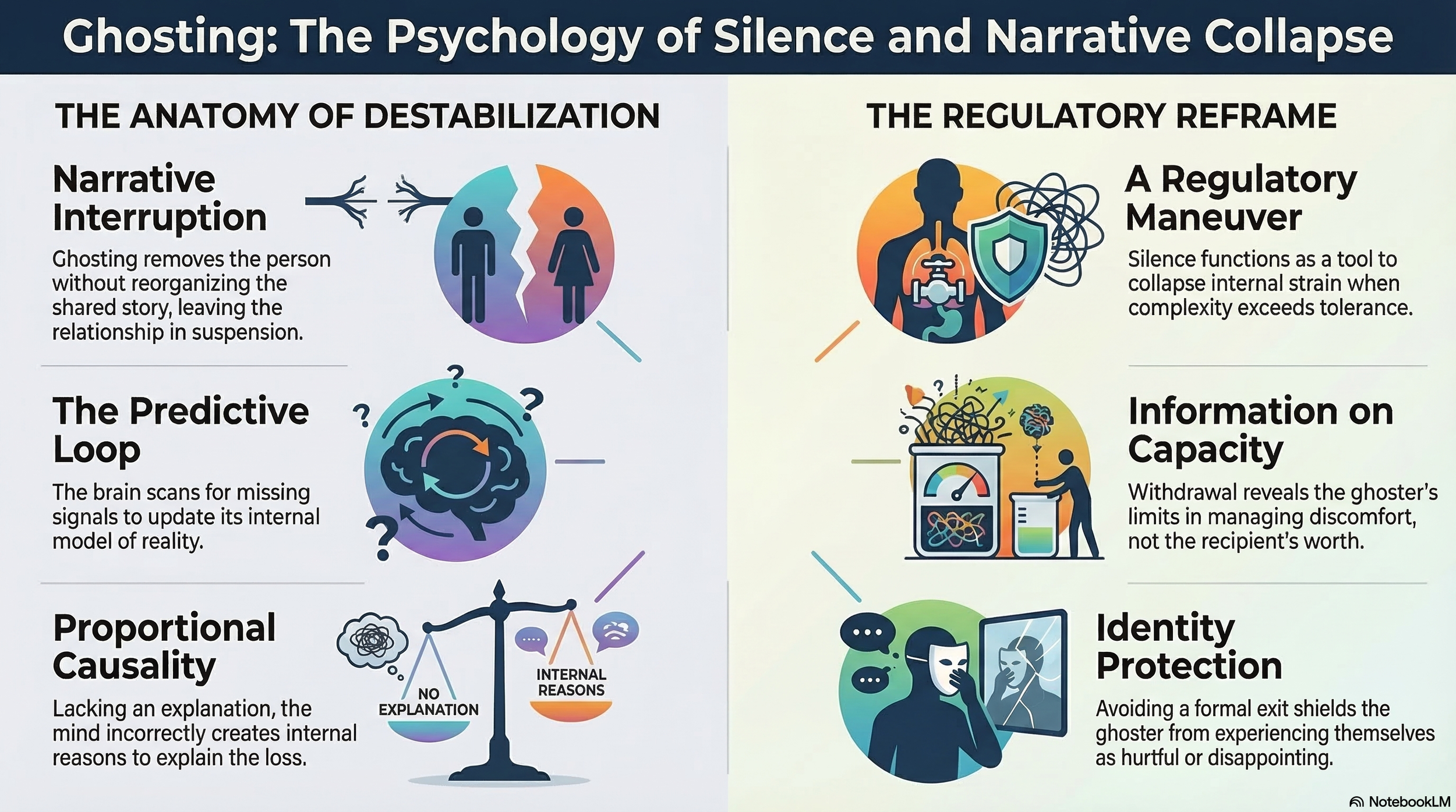
Ghosting does not close the loop. It withdraws the person without providing the signal that would allow the loop to close. What remains is not simply the emotional residue of loss. It is a cognitive system in a sustained state of unresolved processing — scanning for information that is not coming, generating competing hypotheses about what has happened, unable to complete the update that would allow the relational architecture to reorganize.
What the Brain Does With Relational Predictions
The brain is a prediction machine. Its primary function is not to process the present but to anticipate the future based on patterns accumulated from the past. Every established relationship generates a predictive model — a set of expectations about how that person will behave, how they will respond, and what the contours of the connection will look like across time. These models are not abstract. They are embedded in the brain's ongoing processing, shaping attention, interpretation, and emotional response continuously and largely automatically.
When a relationship is active and functioning normally, the predictive model is confirmed repeatedly. The person responds as expected. The connection unfolds in ways that match the model. The system is stable. When something unexpected occurs — when the pattern breaks — the brain registers a prediction error: a discrepancy between what was anticipated and what actually happened. This discrepancy activates the system's error-correction processes. It directs attention toward the anomaly, generates hypotheses about what caused it, and mobilizes the cognitive and emotional resources required to update the model.
A clear termination signal — even a painful one — is a prediction error that comes with its own explanation. The model is wrong not because there is something missing but because the relationship has ended. The brain knows what to do with this information. It is effortful and emotionally costly to update a relational model built over time, but the process has a direction. The system knows what it is updating toward: a model in which this person is no longer a relational partner, and in which the expectations organized around them need to be revised.
Ghosting is a prediction error without an explanation. The model is wrong — the person is no longer responsive — but the brain has no information about why. The anomaly has been registered but cannot be resolved because the information required to resolve it has not been provided. The error-correction process activates, directs attention toward the problem, generates hypotheses. And then it generates more hypotheses, because none of the ones it has generated can be confirmed or disconfirmed. The process continues not because the system is malfunctioning but because it is doing exactly what it is designed to do — scanning for the information it needs to close the loop — and that information is simply not available.
The Sustained State of Unresolved Processing
This is the neurological core of what makes ghosting distinctively destabilizing. The experience is not simply one of loss or rejection. It is the experience of being held in a sustained state of cognitive unresolved-ness — a state in which the predictive system cannot complete its update because the information required for completion has been withheld.
The phenomenology of this state is characteristic. The person finds themselves returning repeatedly to the last interaction — scanning it for information that might explain what happened. They replay conversations, messages, and moments, looking for the detail they missed, the signal they misread, the moment the shift occurred. This is not rumination in the pathological sense, though it can develop into that. It is the predictive system doing its job — seeking the error in the model, trying to locate the information that will allow the update to complete.
What makes this state unusually difficult to exit is that the information being sought is not available anywhere in the past record of the relationship. The explanation for the ghosting is located in the other person's internal state, which the ghosted person does not have access to. There is no amount of reviewing the history that will produce the missing information because the missing information was never in the history. It exists only in a consciousness that has chosen not to communicate it.
The brain does not easily accept that the information it requires for update simply does not exist. Learning systems are built around the assumption that relevant information about a situation can be found if the scanning is sufficiently thorough. This assumption is correct in most contexts. It produces the persistent cognitive engagement with unsolvable problems that defines the experience of being ghosted — the repetitive return to the question, the continued search for an explanation that the architecture of the situation makes unavailable.
Why Ambiguity Generates Self-Indictment
The sustained state of unresolved processing produces a secondary effect that is psychologically significant and frequently underappreciated: the tendency of ambiguous situations to generate explanations that locate the problem in the self.
This is a feature of how the brain handles uncertainty. When the cause of a negative event is unknown, the mind generates hypotheses. The most immediately available dataset for hypothesis generation is the self — the person's own behavior, characteristics, and history. In the absence of external information about why something happened, the mind turns inward and asks what about me caused this.
In the context of a clear rejection, this tendency is constrained by the explanation that has been provided. Even if the explanation is unsatisfying, it gives the mind something to work with — a cause that is external to the self, located in the other person's preferences or circumstances rather than in some fundamental inadequacy of the person being rejected. The loop of self-interrogation has a limit.
Ghosting removes that limit. The absence of explanation leaves the mind to generate its own, and in the absence of external information, the internal database is all that is available. The hypotheses that emerge tend to be disproportionate — not specific accounts of what might have made this particular connection unsuitable, but global indictments of fundamental worth. The question shifts from why did this not work to what is wrong with me that this keeps not working, or more precisely, what is so wrong with me that the other person could not even bring themselves to explain.
This is not a rational inference. It is the predictable output of a cognitive system that needs an explanation, has been denied an external one, and has only the self as an available source of causal attribution. Understanding this mechanism does not dissolve the experience of self-indictment, but it reframes it. The self-directed explanation is not a discovery of something true. It is a hypothesis generated by a system that cannot tolerate the alternative — that no explanation exists and that the information required for update will simply never arrive.
The Relational Identity Disruption
Beyond the cognitive disruption, ghosting produces a specific form of identity disturbance that operates through a different mechanism. Established relationships are not simply social connections. They are, in varying degrees, scaffolding for identity — structures within which the person understands aspects of who they are, how they are regarded, and what kind of future they are moving toward.
When a relationship ends with explanation, the identity reorganization it requires is painful but structured. The person knows what the change is, can update their self-understanding in response to the information provided, and can revise the relational dimensions of their identity — who they are in relation to this person — with some degree of clarity about what they are revising toward.
When a relationship ends through ghosting, the identity reorganization is structurally incomplete. The relationship is over — the absence of contact makes that practically clear — but the cognitive and emotional processing that would allow identity reorganization to occur cannot complete because the termination has not been formally acknowledged. The relationship occupies a strange in-between state: functionally ended but narratively unresolved. The person cannot close the chapter because the chapter has not been given an ending.
Within Psychological Architecture, this connects to the Identity domain's function as a narrative stabilization system. Identity requires coherence — a continuous story of who the person is, who they have been in relation to others, and where the story is going. Ghosting introduces a narrative gap: a relationship that was part of the ongoing story has been removed from the plot without explanation. The narrative cannot cohere around the gap because there is nothing to cohere around. The relationship is neither in the story nor formally concluded. It simply stops, and the story is left with an unresolved thread that the narrative architecture cannot integrate.
The Distinction That Matters
The psychological significance of understanding ghosting neurologically and cognitively is not primarily therapeutic in the conventional sense. It does not make the experience less painful. What it does is reframe what the pain means — specifically, it separates the experience of destabilization from the interpretation that the destabilization is evidence of personal inadequacy.
The destabilization of being ghosted is not a measure of how much the ghosted person cared, how fragile they are, or how much the relationship meant relative to their overall resilience. It is a structural outcome of having a predictive system that requires a termination signal to complete its update and being denied that signal. The brain is doing exactly what brains do — seeking the information it needs to close the loop, generating hypotheses in the absence of that information, and experiencing the sustained cognitive load of unresolved processing as something that feels like disturbance and urgency.
What ghosting withholds is not simply closure in the colloquial sense. It withholds the structural condition that the brain requires to complete a specific cognitive process. The person left behind is not experiencing disproportionate sensitivity. They are experiencing the predictable neurological and cognitive consequence of a specific kind of informational withholding — one that leaves the predictive system in a state of sustained unresolved activity from which the normal path of exit has been removed.
The silence is not a verdict. It is an absence of information. The destabilization it produces is not a revelation of weakness. It is the signature of a cognitive system working correctly in conditions that have been structured to prevent it from completing its work.
This essay examines one structural dimension of human functioning within the framework of Psychological Architecture. The complete integrative model is developed in the monograph Psychological Architecture: A Structural Integration of Mind, Emotion, Identity, and Meaning. Ghosting is examined at length in Gone Without Goodbye: The Psychology of Ghosting Across Love, Friendship, Family, and the Modern World.