
The Architecture of Being Human
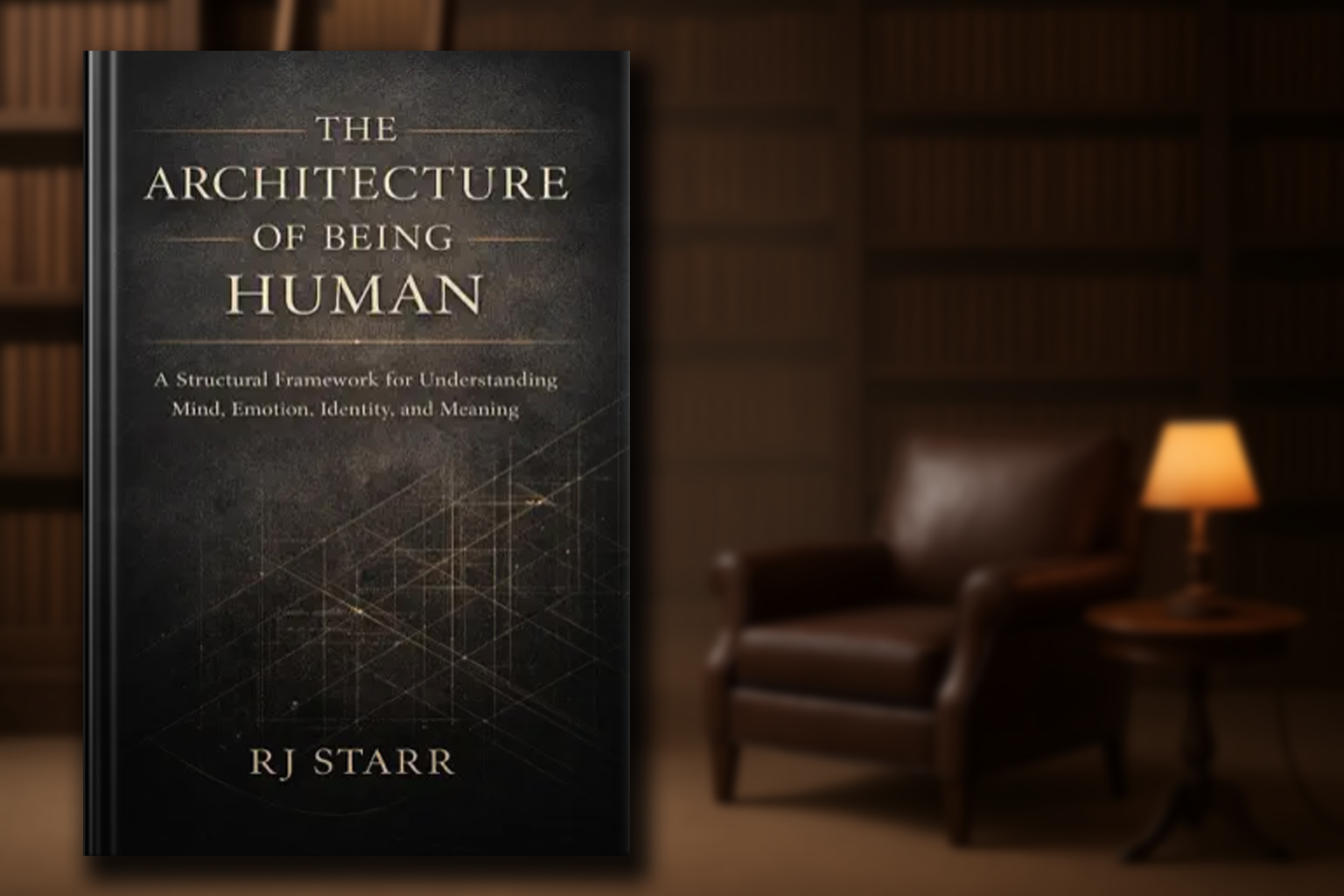
The Architecture of Being Human: A Structural Framework for Understanding Mind, Emotion, Identity, and Meaning presents a structured account of human experience, organized around the interaction of four domains: mind, emotion, identity, and meaning.
A Way of Seeing What Has Always Been There
Most people know their psychological life far better than they understand it. They know they become reactive in certain conversations but cannot explain what organizes that reactivity. They know that loss disrupts more than mood, it seems to alter something in the way the world fits together. They know that some problems persist despite genuine effort, despite insight, despite years of reflection, and they cannot fully account for why.
The reason is structural.
Beneath the visible content of psychological life lies an organizing system. Most people live within it without ever seeing it. The Architecture of Being Human brings that system into view.
What This Book Introduces
The Architecture of Being Human: A Structural Framework for Understanding Mind, Emotion, Identity, and Meaning presents Psychological Architecture in its most accessible and complete form.
Psychological Architecture is the study of how mind, emotion, identity, and meaning form the structural system through which human experience is organized. These domains do not operate independently. They interact continuously, shaping how events are perceived, how emotions arise and regulate, how the self maintains coherence across time, and how individuals locate their lives within frameworks of significance and direction.
Within this architecture:
Mind functions as the interpretive engine. It does not passively record events but actively constructs them, filtering information, generating predictions, and assigning significance before conscious awareness fully arrives.
Emotion functions as the regulatory system. It signals what matters, directs attention, mobilizes response, and registers connection, threat, loss, and significance.
Identity functions as the organizing narrative. It provides continuity across time, integrating memory, roles, values, and self-perception into a framework stable enough to anchor experience.
Meaning functions as the integrative structure. It situates personal life within broader frameworks of purpose, value, and existential orientation, determining whether experience appears coherent, fractured, worthwhile, or empty.
These domains are analytically distinct but continuously interacting. When they remain relatively aligned, individuals tend to experience coherence and stability. When they strain against one another, the effects appear across the entire system. What seems like an isolated difficulty often reflects a broader structural tension.
Why a Structural Perspective Matters
Psychology has produced an enormous body of knowledge about human experience. It has examined cognition, emotion, attachment, personality, development, and meaning with depth and precision. Yet much of this knowledge has developed through specialization, with different domains studied in isolation.
In lived experience, these domains do not appear separately. A career failure is not merely disappointment. It may also destabilize identity, distort interpretation, alter emotional regulation, and disrupt a person’s sense of direction. Grief is not only sadness, it is altered structure. The world no longer means what it meant before.
Fragmented psychology can describe parts of these processes well while still missing the form of the whole.
Psychological Architecture addresses this limitation by beginning from the structure of experience itself. It offers a way of seeing how interpretation, emotion, identity, and meaning operate together within a single system. The result is not an additional set of concepts, but a different level of analysis, one that makes recurring patterns of experience intelligible where they previously appeared arbitrary.
How the Book Is Organized
The book unfolds across ten chapters, moving from foundational perspective to applied structural models and broader implications.
The opening chapter establishes the central claim that human beings live within psychological systems they rarely perceive directly. The following chapters examine each domain in turn, exploring how the mind constructs experience, how emotion regulates response, how identity organizes continuity, and how meaning situates life within a broader horizon.
Later chapters address structural instability, examining how tensions across domains produce recurring patterns of difficulty. Five structural models are introduced as analytical lenses, including the Emotional Avoidance Loop, the Identity Collapse Cycle, the Self-Perception Map, the Emotional Maturity Index, and Emotional Repatterning.
This volume was completed prior to the formal development of Existential Drift, the sixth structural model within Psychological Architecture, as well as the Meaning Dissolution Model, the seventh model. Both models were incorporated into the monograph and other framework materials. A future edition of this book will include it.
The final sections of the book examine integration, the conditions under which psychological systems reorganize, and the broader implications of a structural understanding of human experience.
The Position of This Volume Within the Broader Framework
This book occupies a specific position within the development of Psychological Architecture.
The formal monograph presents the framework in its complete theoretical and academic form. The Psychology of Being Human: An Authoritative Guide to Mind, Emotion, and Meaning articulates the broader conceptual foundation across a comprehensive treatment of psychological life.
The Architecture of Being Human serves as the primary entry point. It presents the full structure of the framework in a form that is more accessible without altering its underlying logic.
The volumes are complementary. This book may be read independently as a complete account of the framework, or alongside the monograph and related work. What differs is not substance, but register.
What Readers Will Come Away With
By the end of this book, readers will have a structural account of how psychological life is organized.
They will be able to recognize how interpretation, emotion, identity, and meaning interact to produce recurring patterns of experience. They will understand why certain difficulties persist despite insight, and why change often requires more than addressing a single domain in isolation.
The aim is not to provide prescriptions, but to render the architecture of experience visible. That visibility is itself a shift in how psychological life can be understood.
Who This Book Is For
For general readers seeking a more complete understanding of psychological life beyond isolated concepts or labels.
For students and educators in psychology and related fields who want an integrated, systems-level perspective on human experience.
For clinicians and practitioners who recognize that many forms of distress reflect tensions distributed across multiple domains.
For researchers and theorists interested in models that operate at the level of interaction rather than isolated mechanisms.
For institutions and programs where questions of identity, meaning, and psychological stability extend beyond the individual and into larger systems.
This book does not presume pathology. It presumes complexity.
The Architecture of Being Human: A Structural Framework for Understanding Mind, Emotion, Identity, and Meaning is published by Depthmark Press (2026).
ISBN: 979-8-9996293-6-4
This volume may be read independently or alongside the formal monograph and related work within the Psychological Architecture framework.