
Structural Failure: The Architecture of Human Disconnection
Structural Failure: The Architecture of Human Disconnection is a diagnostic work in structural psychology examining why human connection is breaking down at the current historical moment — not as a failure of character, technology, or politics, but as the predictable output of psychological systems operating under conditions that no longer support the relational outcomes those systems evolved to produce. Drawing on Psychological Architecture, the book develops a structural account of misreading, relational failure, identity conflict, and what becomes possible when the mechanism, not the behavior, is correctly located.
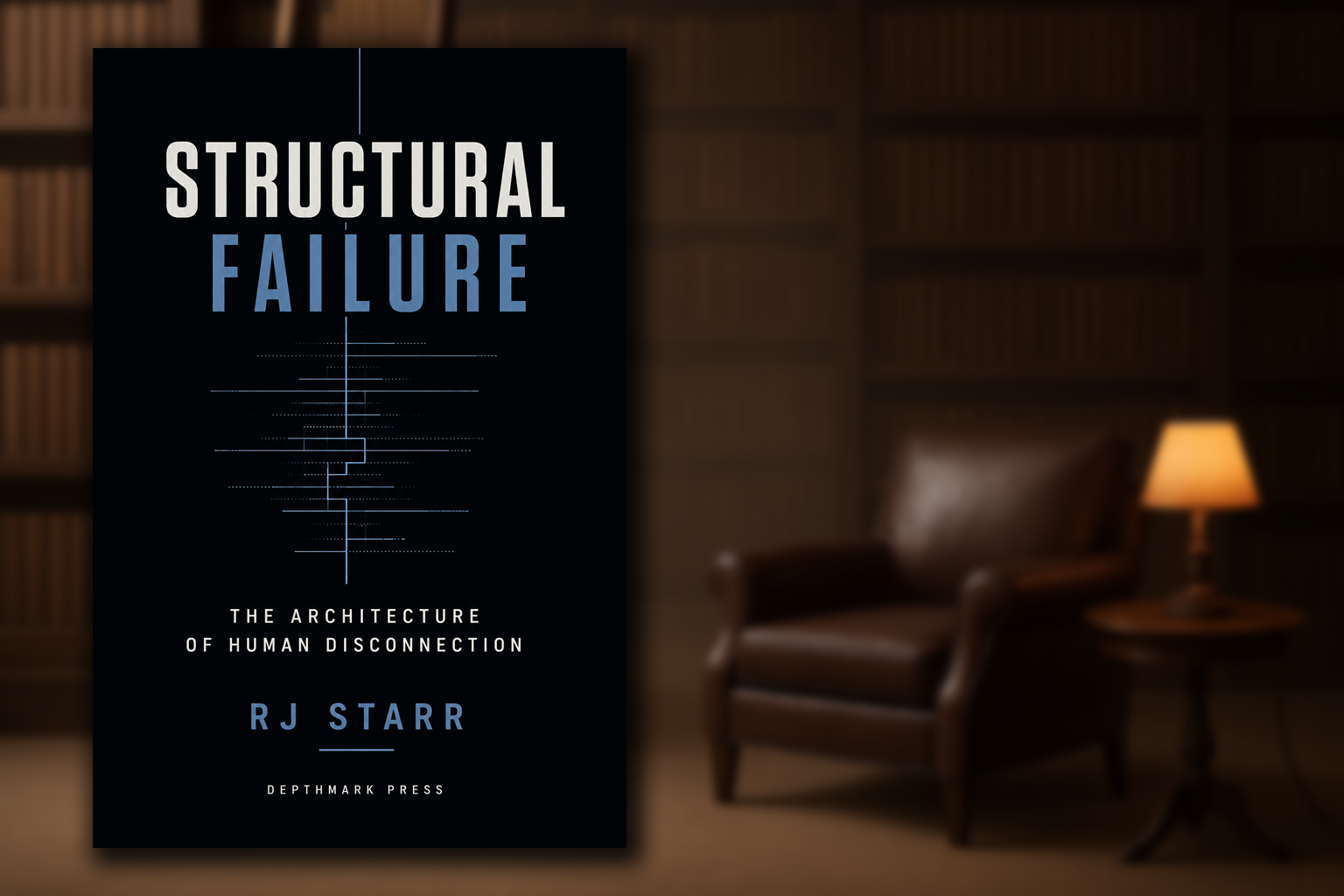
Structural Failure: The Architecture of Human Disconnection is a diagnostic work. It does not explain what is wrong with people. It explains what is wrong with the conditions under which people are operating — and why those conditions are producing disconnection as a structural output rather than as a personal failing.
The Problem Is Not What You Think It Is
Most people alive today carry a persistent sense that something about human connection has changed. Conversations end badly or stop entirely. Friendships thin and then vanish without explanation. Public life has become exhausting in a way that seems out of proportion to any single cause. People report feeling unseen, misread, and strangely alone even in the presence of others.
The standard explanations are familiar. Social media has replaced authentic connection with performance. Political polarization has shattered civic trust. Economic precarity has narrowed the bandwidth available for relationships. Each of these accounts captures something real. None of them is sufficient. They identify contributing conditions without identifying the mechanism. They describe the environment in which disconnection has intensified without explaining the structural logic by which environments produce the behavior we are observing.
Structural Failure offers a different kind of account. The disconnection of the current moment is not a political failure, a technological failure, or a moral failure. It is a structural failure: the predictable output of psychological systems operating exactly as designed, inside conditions that no longer support the relational outcomes those systems evolved to produce. The breakdown is not happening because people have become worse. It is happening because the structural conditions that once made connection possible, reliable, and self-reinforcing have changed — and the behaviors that result from those changed conditions look, from the inside, like collapse.
What This Book Is
Structural Failure is a diagnostic work. Its purpose is to explain what is happening, not to propose remedies. This is a deliberate choice. The impulse to move quickly from diagnosis to prescription is one of the most reliable ways to produce a book that feels useful in the first half and increasingly hollow in the second. A structural problem located correctly is already more actionable than a problem misidentified.
When you understand that silence after a conflict is not rejection but exit-capacity failure, you are in a different position than when you believe the person has simply stopped caring. When you understand that contempt is not a personality trait but a structural output of specific conditions, you are better positioned to recognize what is actually happening in a conversation that has gone wrong. When you see that political rigidity is a downstream expression of identity architecture rather than an upstream cause of social dysfunction, you stop expecting that the problem can be argued away.
These are not small recognitions. They do not fix anything. They do, however, change what is visible. And what is visible determines what is possible.
What the Book Examines
The book is organized around a single sustained argument developed across five parts.
Part One examines the existing explanations for social breakdown, acknowledges what each gets right, and identifies what each leaves unresolved. It introduces the structural lens that the remainder of the book applies — and makes the case that behavior is structurally produced, not primarily chosen.
Part Two examines how we misread each other. It addresses judgment as identity stabilization, the structural organization of attention and interest, parochial attribution as the projection of local maps onto shared terrain, and the specific dynamics that emerge when interpretive capacity itself becomes an identity-organizing structure. These are not failures of goodwill. They are structural features of the psychological systems doing the perceiving.
Part Three examines how connection breaks. It addresses ghosting and the architecture of exit, orbiting and the economics of attention and proximity, jealousy and the quantification of relational attention, and the failure of recognition at the domestic scale — inside the marriages, partnerships, friendships, and family relationships where disconnection matters most and is least visible.
Part Four examines how identity produces conflict. It addresses the hardening of belief into structural feature, the defensive architecture that organizes the self around protection rather than integration, the developmental condition of psychological immaturity in adult bodies, and the specific mechanisms through which the political environment has become one of the most powerful architects of how people think, feel, and relate.
Part Five asks what changes when the structural account is genuinely held — not as a position, but as a way of seeing. It examines structural literacy: the capacity to read behavior as the output of systems, to locate mechanism beneath surface presentation, and to understand what the conditions of human disconnection actually require.
The Framework Behind the Analysis
The analytical lens this book uses is Psychological Architecture, a structural framework developed across a body of work that includes a formal monograph, a series of essays, and the introductory text The Architecture of Being Human.
Psychological Architecture proposes that human psychological life is organized across four interacting domains: mind, emotion, identity, and meaning. These domains do not operate independently. They form a system, and it is the organizational state of that system — not any isolated component of it — that determines how a person interprets experience, regulates affect, sustains a sense of self, and orients toward purpose.
Within that system, the framework draws a central distinction between coherence and rigidity. A coherent psychological system maintains alignment across its domains through flexible updating. A rigid system maintains apparent stability through a different mechanism: it holds together by narrowing its operating range, foreclosing inputs that would require adaptive revision, and substituting the management of discomfort for its integration. Most of the behaviors examined in this book — from ghosting to contempt to political tribalism to the quiet withdrawal of recognition in a marriage — are expressions of rigidity under pressure rather than expressions of coherence under strain.
The framework appears in this book the way a lens appears in a photograph. You see what it reveals. You do not spend the book examining the lens.
What This Book Is Not
It is not a self-help book. There are no chapters that close with exercises. There are no practices to install, no habits to cultivate, no morning routines that will restructure your relational life.
It is not a political book. The political dimension of social breakdown appears in these pages, but it appears as a symptom rather than a cause. The analysis does not take sides. The same mechanisms that produce ideological rigidity on one end of a spectrum produce it on the other. Identity defensiveness is not a left problem or a right problem. It is a structural problem, and it operates with equal reliability wherever identity structure is under sufficient pressure.
It is not optimistic. The book does not end with a redemption narrative. It does not argue that things will improve, or that awareness of the problem is sufficient to reverse it. What structural literacy offers is not hope in the ordinary sense. It offers accuracy. And accuracy, in a landscape saturated with false explanation, is not nothing.
The Position of This Book Within the Broader Work
Structural Failure applies the Psychological Architecture framework to a specific problem: the structural failure of human connection at the current historical moment. It presupposes no prior familiarity with the framework. Readers who are new to Psychological Architecture will encounter the concepts as they become relevant to the analysis, introduced in ordinary language rather than technical terminology.
The Architecture of Being Human serves as the primary entry point to the framework itself for readers who want the foundational account. The formal monograph presents the framework in its complete theoretical and academic form. Structural Failure takes the framework as an instrument and turns it on a specific problem. The volumes are complementary. Each stands alone.
Who This Book Is For
For readers who have felt the ambient disconnection of the current moment and want an account of it that goes deeper than the standard explanations.
For students and educators in psychology, sociology, political science, and related fields who want a structural, systems-level analysis of social breakdown.
For clinicians and practitioners who recognize that many forms of relational distress reflect conditions as much as character.
For researchers and theorists interested in how psychological architecture scales from individual experience to collective dysfunction.
For anyone who has been ghosted, misread, argued past, or quietly unseen in a relationship that was supposed to provide recognition — and who wants to understand what is actually producing those experiences.
This book does not presume pathology. It presumes that the conditions are structural, and that structural conditions can be named.
Structural Failure: The Architecture of Human Disconnection is published by Depthmark Press (2026). Paperback ISBN: 979-8-9996293-8-8
This volume may be read independently or alongside The Architecture of Being Human and the Psychological Architecture monograph.